
8 Essential Business Card Design Tips for Local Brands
In a world of fleeting digital connections, a well-designed business card remains a powerful, tangible reminder of your brand. It’s a handshake, a brand statement, and a direct line to your next customer, all packed into a few square inches. For small business owners in Portage, Indiana, and across the Chicagoland area, a memorable card can be the difference between being forgotten and getting the call. While digital marketing is essential, many business experts still discuss why physical prints still matter for making a lasting impression during in-person networking.
But how do you create a card that truly works for your business? This guide moves beyond the basics to provide actionable business card design tips tailored for contractors, salon owners, and local entrepreneurs. We'll explore everything from choosing high-quality materials and mastering visual hierarchy to incorporating your brand identity and adding a clear call-to-action. Forget flimsy, forgettable cards that get tossed in a drawer. Let's design a mini-billboard that your ideal customers will actually want to keep. At Creative Graphics Solutions, we believe great design is your hardest-working employee, and it all starts with getting these fundamentals right. Call us at 219-764-1717 to see how we can help.
1. Choose Quality Materials and Finishes
Before a potential customer even reads your contact information, they feel your business card. The weight, texture, and finish create an immediate, subconscious impression of your brand. A flimsy, generic card suggests corner-cutting, while premium materials convey professionalism, quality, and attention to detail. This tactile experience is a powerful tool in your branding arsenal, making it one of the most critical business card design tips to master.
For service-based businesses in Northwest Indiana, from Portage to Valparaiso, this first touchpoint is crucial. The quality of your card directly reflects the quality of your work.
Why Material and Finish Matter
Think of your business card as a handshake. A firm, confident handshake inspires trust; a weak one does the opposite. Similarly, a thick, well-finished card feels substantial and memorable. It shows you invest in your brand and, by extension, in the quality of service you provide to your clients.
Key Insight: The physical feel of your business card is a non-verbal cue about your brand's value. A premium finish suggests a premium service, helping you stand out from competitors who opt for basic, budget options.
Practical Examples for Local Businesses
Matching the material to your industry reinforces your brand message effectively:
HVAC & Contractors: A thick, 32pt card with an embossed metal-effect finish or a subtle spot UV on the logo can convey durability and expertise.
Salons & Barbershops: A soft-touch matte lamination on a heavy cardstock feels luxurious and upscale, perfectly matching the high-end client experience you provide.
Non-Profits & Eco-Conscious Brands: Using 100% recycled, uncoated cardstock visibly demonstrates your commitment to your values.
Food Trucks & Retail: Consider durable, waterproof-coated finishes or unique die-cut shapes that mimic your logo or a signature product to be more memorable.
Actionable Tips
Always Request Samples: Never commit to a large order without feeling the paper and seeing the finish first.
Align with Your Brand: A playful, creative agency might use a bold, die-cut shape, while a financial advisor should stick to a classic, elegant linen or felt texture.
Consider Durability: If your cards will be handled frequently or exposed to the elements, like for a contractor in Chicagoland, choose a more resilient finish.
Choosing the right materials is a key step. For a deeper dive into how different stocks and finishes can impact your final product, you can learn more about professional printing options. At Creative Graphics Solutions, we can guide you through the best choices for your brand. Call us at 219-764-1717 to discuss your project.
2. Maintain Clear Visual Hierarchy and Readable Typography
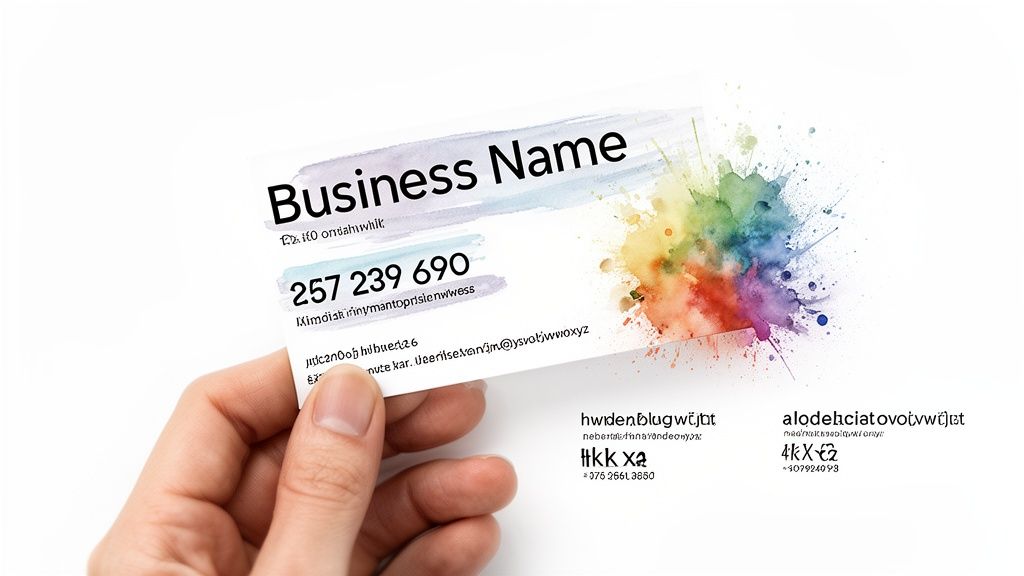
A great business card doesn't just list information; it guides the reader's eye. Visual hierarchy is the art of arranging elements to show their order of importance. By using strategic font sizes, spacing, and visual weight, you ensure potential clients can instantly scan and find what they need. A card that’s cluttered or hard to read will be quickly discarded.
For busy professionals in Northwest Indiana, from contractors to salon owners, a card that communicates key details in a split second is an invaluable tool. Effective hierarchy is a cornerstone of professional business card design tips that turns a simple card into a powerful networking asset.
Why Hierarchy and Typography Matter
Your card has less than five seconds to make an impact. If a potential customer has to hunt for your phone number or can't read your name, you've lost the opportunity. Clear typography makes your information accessible, while strong hierarchy directs attention, starting with your name or logo and flowing logically to the most critical contact point, like your phone number.
Key Insight: A well-organized business card shows respect for the recipient's time. By making your information easy to digest, you project an image of a business that is organized, professional, and easy to work with.
Practical Examples for Local Businesses
Tailoring the hierarchy to your business goals makes your card more effective:
HVAC Contractors: The business name should be the largest element, followed by a bold, highly visible phone number for emergency calls. A list of key services (e.g., "24/7 Service," "Heating & Cooling") should be clear but secondary.
Salon & Barbershop Owners: Your name and salon name are primary. The most prominent contact detail should be the phone number for calls/texts or your online booking site. Social media handles can be smaller and less emphasized.
Non-Profits: The organization’s name and a concise mission statement should grab attention first. The "How to Donate" or "Volunteer" contact info should be the clearest and most direct call to action.
Actionable Tips
Mind Your Font Size: Use at least a 14pt font for your name and 8pt for contact info. Anything smaller becomes difficult to read.
Limit Your Fonts: Stick to a maximum of two font families (e.g., a bold sans-serif for headlines and a clean serif for body text) to avoid a chaotic look.
Embrace White Space: A cluttered card is an unreadable card. Aim to leave 30-40% of your card as "empty" space to give elements room to breathe.
Test for Readability: Before placing a large order, print a sample at the actual size to ensure every word is legible and the hierarchy works as intended.
Getting the typography and layout right is fundamental. At Creative Graphics Solutions, we specialize in creating designs that are not only beautiful but also functional. Call us at 219-764-1717 to start designing a card that gets noticed.
3. Incorporate Your Brand Colors and Logo Effectively
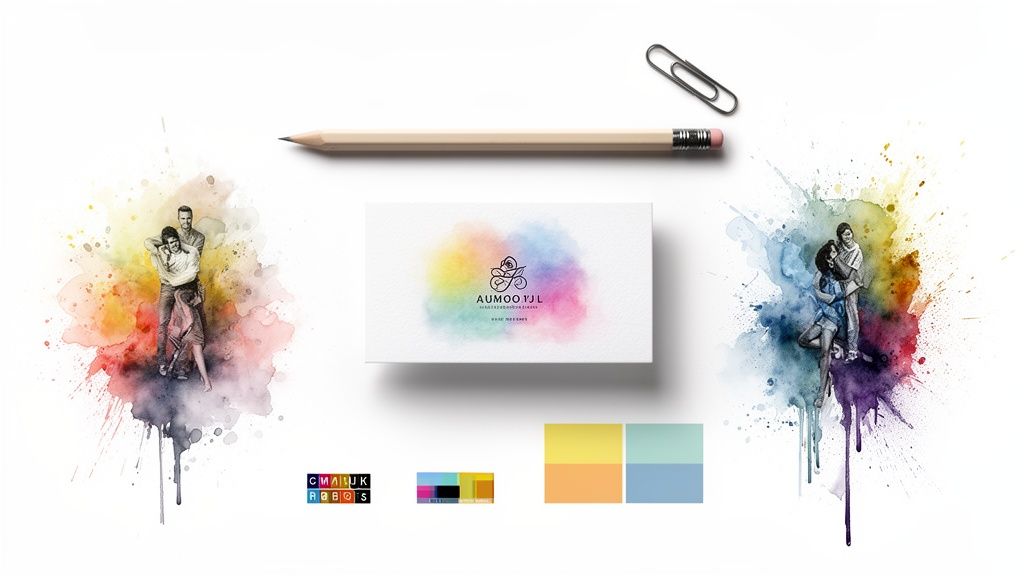
Your business card is a pocket-sized billboard for your brand. Using your established logo and color palette consistently is one of the most fundamental business card design tips because it builds immediate recognition. When a potential client in Portage or across Northwest Indiana sees your card, it should instantly connect to the branding they've seen on your website, service vehicle, or storefront, reinforcing trust and familiarity.
Strategic color and logo placement turns a simple contact card into a cohesive piece of your marketing ecosystem. It ensures your brand identity is strong, professional, and memorable, long after the initial introduction.
Why Color and Logo Consistency Matter
Imagine seeing an HVAC truck with a bold blue and orange logo, then receiving a business card with a completely different green and yellow design. This disconnect creates confusion and undermines brand credibility. Consistent branding signals professionalism and reliability, assuring customers that you are an established, trustworthy business. Your colors evoke emotion and your logo is your signature; using them correctly is non-negotiable.
Key Insight: Your logo and brand colors are the visual shorthand for your business. Consistent application across all materials, especially your business card, builds brand equity and makes your business instantly recognizable.
Practical Examples for Local Businesses
Aligning your card's visual identity with your overall brand creates a powerful and cohesive message:
HVAC & Contractors: Use your primary brand colors, like a specific blue and orange, to match your truck wraps and technician uniforms. This creates a seamless and professional brand experience.
Upscale Salons: A minimalist black card with the logo printed in a rose gold foil accent immediately communicates luxury and aligns with a high-end salon interior.
Food Trucks: The vibrant, eye-catching colors that make your truck stand out in a crowd should be the centerpiece of your business card design, making it just as fun and memorable.
Non-Profits: A local environmental non-profit should use its mission-aligned colors, such as earthy greens and blues, to reinforce its core values on every piece of communication.
Actionable Tips
Provide CMYK Color Codes: To ensure accurate color reproduction, always give your printer the CMYK values for your brand colors, not RGB.
Mind the Logo Size: Your logo should be legible but not overwhelming. A good rule of thumb is to keep it at least 0.5 inches wide for clear printing.
Create Logo Variations: Have versions of your logo (full color, one color, and a reversed-out white version) ready to ensure it looks great on any background.
Limit Your Color Palette: Stick to two or three of your main brand colors to avoid a cluttered look and keep printing costs manageable.
A well-designed logo is the foundation of your brand's visual identity. To explore this topic further, you can learn more about professional logo design. The team at Creative Graphics Solutions can ensure your branding is applied perfectly to your next set of business cards. Call us today at 219-764-1717 for a consultation.
4. Include Essential Contact Information and a Call-to-Action
A beautiful design is wasted if a potential client cannot figure out how to contact you. Your business card's primary function is to connect people to your business, so making that information clear, concise, and easy to act on is non-negotiable. This goes beyond just listing details; it’s about strategically guiding the recipient toward the next step you want them to take.
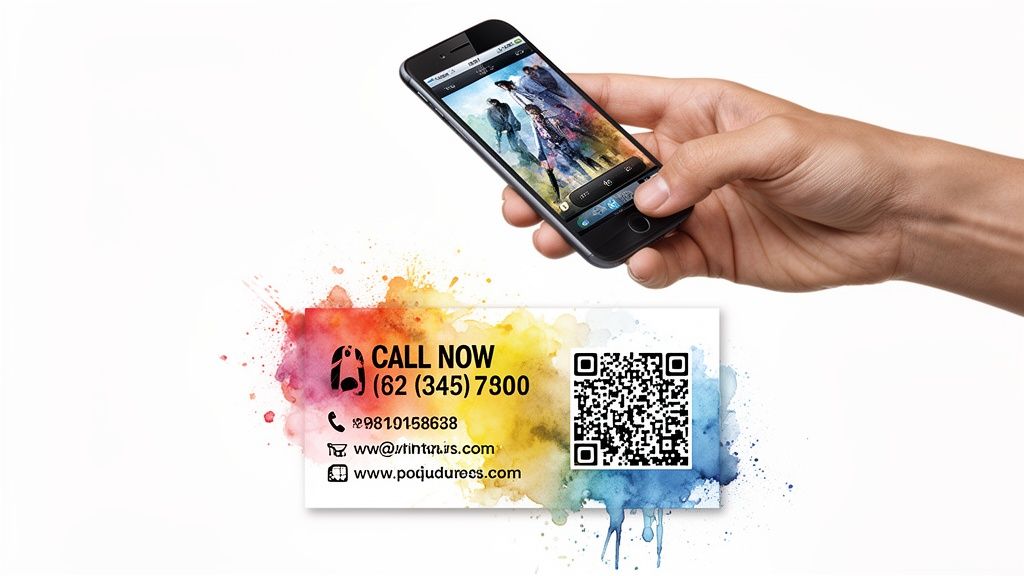
For service-based businesses in Northwest Indiana, a card that clearly presents a phone number and a call-to-action (CTA) like "Call for a Free Quote" is far more effective than one that simply lists a website. It removes friction and encourages immediate engagement. This is one of the most fundamental business card design tips for driving real results.
Why Contact Info and a CTA Matter
Your business card should be an active marketing tool, not a passive directory listing. By including a direct CTA, you transform the card from a simple piece of information into an invitation. You are explicitly telling the person what to do next, whether it's booking an appointment, visiting your website, or following you on social media. This clarity significantly increases the likelihood of a follow-up.
Key Insight: A business card without a clear call-to-action is a missed opportunity. Guide your audience by telling them exactly what to do with the information you’ve provided to turn a contact into a customer.
Practical Examples for Local Businesses
Tailor your contact details and CTA to your specific business model for maximum impact:
HVAC & Contractors: Make your service phone number the most prominent contact detail. Include a CTA like "Call for 24/7 Emergency Service" or "Get a Free Estimate."
Salons & Barbershops: Feature your booking phone number and Instagram handle. Use a QR code that links directly to your online appointment scheduler with the CTA "Book Your Appointment Now."
Food Trucks: List your social media handles (for location updates) and website. A great CTA is "Follow Us for Daily Locations!" to build a loyal following.
Non-Profits: Include a QR code linking to your donation page. Use a compelling CTA like "Scan to Support Our Cause" alongside your primary contact information for volunteers.
Actionable Tips
Prioritize for Your Industry: For service businesses in Portage, a bold phone number is key. For a retail shop, the website and physical address may be more important.
Include a Clean URL: Display your website URL without the "https://www." prefix (e.g., yourdomain.com) for a cleaner, more modern look.
Use QR Codes Strategically: Ensure QR codes are at least 0.5 x 0.5 inches for easy scanning and link them to a high-value destination, like a booking page or a special offer.
Keep it Legible: Choose a clean, simple font for contact information and ensure it has enough contrast with the background to be easily readable.
Getting the hierarchy of information right is critical. At Creative Graphics Solutions, we can help design a card that not only looks great but also works hard for your business. Call us at 219-764-1717 to start designing.
5. Optimize the Back Side for Additional Value
Leaving the back of your business card blank is a massive missed opportunity. In a world where every inch of marketing real estate counts, the reverse side is valuable space to engage, inform, and persuade potential customers. Using this area strategically transforms your card from a simple contact slip into a powerful mini-brochure that works harder for your brand. This is one of the most practical business card design tips for maximizing impact.
For busy contractors and service professionals across Northwest Indiana, from Portage to Merrillville, the back of your card can close the information gap and encourage an immediate next step.
Why the Back Side Matters
The front of your card accomplishes the introduction: who you are and how to reach you. The back is where you answer the next logical question: "Why should I choose you?" It's your chance to provide compelling reasons, showcase your expertise, or offer an incentive that prevents your card from being discarded.
Key Insight: A strategically designed back side turns a passive exchange of contact info into an active brand experience. It provides extra value that makes your business more memorable and gives clients a clear reason to follow up.
Practical Examples for Local Businesses
The best use of this space connects directly to your business goals and customer needs:
HVAC & Contractors: List your core services like Heating, Cooling, and Maintenance Plans. You could also add a small "Ask about our seasonal tune-up special" to prompt a conversation.
Salons & Barbershops: Showcase a menu of your most popular services (e.g., color treatments, precision fades, beard trims) or include a short, glowing client testimonial for social proof.
Non-Profits: Use the back to print your mission statement or a powerful statistic that illustrates your impact (e.g., "Your $10 donation feeds a family for a day").
Food Trucks & Retail: Feature a map of your location, weekly specials, or a loyalty stamp section (e.g., "Buy 5, get the 6th free").
Actionable Tips
Maintain Brand Consistency: Use the same fonts, colors, and logo elements from the front to create a cohesive and professional design.
Prioritize Simplicity: Don't clutter the back with too much text. Focus on one key message, whether it's a list of services, a special offer, or a call to action.
Add a Testimonial: A single, powerful quote from a happy customer builds instant credibility and trust.
Include a Clear Call to Action: Tell people what to do next. "Visit our website for a free estimate," "Follow us on social media," or "Book your appointment online."
Using both sides of your card is a smart investment in your marketing. At Creative Graphics Solutions, we can help you design a card that makes a powerful impression from front to back. Call us today at 219-764-1717 to get started.
6. Use Strategic Whitespace to Avoid Overcrowding
What you don't include on your business card is just as important as what you do. Whitespace, or negative space, is the empty area around design elements. Far from being "wasted" space, it creates visual breathing room, improves readability, and projects an image of sophistication and confidence. Overcrowding a small canvas like a business card with too much text or too many graphics can make your brand look chaotic and unprofessional.
For service providers in Northwest Indiana, from Crown Point to Michigan City, a clean, uncluttered card signals a focused and organized approach. It ensures your key message isn't lost in the noise, which is one of the most vital business card design tips for making a strong impression.
Why Whitespace and Simplicity Matter
Think of your business card as a billboard on a highway. A cluttered billboard with tiny text is impossible to read and is quickly forgotten. A billboard with a clear, concise message and plenty of open space grabs attention and is easily understood. Whitespace on your card functions the same way, guiding the viewer's eye to the most important information: your name, your company, and how to contact you.
Key Insight: Strategic use of whitespace is a hallmark of premium branding. It communicates that your brand is confident enough to let the essential elements shine without needing to fill every corner with clutter.
Practical Examples for Local Businesses
A clean, open design can be adapted to any industry to enhance its brand message:
Salons & Spas: An upscale salon card with a centered logo, minimal text, and generous spacing on a premium stock feels luxurious and exclusive.
HVAC & Contractors: A card for a premium contractor might feature just a strong logo, name, and phone number with plenty of breathing room, conveying expertise and no-nonsense efficiency.
Non-Profits: An uncluttered layout helps focus attention on a powerful mission statement or logo, making the organization's purpose clear and memorable.
Retail Boutiques: An elegant, minimalist design with lots of whitespace can reflect a curated, high-end product selection and a sophisticated shopping experience.
Actionable Tips
Establish Margins: Keep all essential text and logos at least 0.25 inches away from the edges of the card to create a clean, un-cramped frame.
Prioritize Information: Resist the urge to list every service. Focus on your brand name, your role, a primary phone number, email, and website.
Guide the Eye: Use whitespace to create a clear visual hierarchy. The more space around an element, like your logo, the more important it will seem.
Consider the Back: If you have more information to share, use the back of the card. This keeps the front clean and focused on making a first impression.
Mastering whitespace is key to creating a design that looks professional, not amateur. To see how a clean layout can elevate your brand, let's talk. Call Creative Graphics Solutions at 219-764-1717 to get started on a design that stands out.
7. Design for Both Digital and Print
In today's interconnected world, your business card exists in two realms: the physical one you hand out and the digital one shared via email or text. A modern business card design must excel in both. Designing for print and digital reproduction ensures your brand identity remains consistent, professional, and functional, whether it's viewed on a screen or held in a hand.
For professionals across Northwest Indiana, from contractors in Portage to salon owners in Valparaiso, this versatility is no longer optional. A card that translates poorly to a digital format can look amateurish and undermine the credibility you've worked hard to build.
Why Digital and Print Versatility Matter
Think about how contacts are saved now. A potential client might take a picture of your card, or you might include a digital version in your email signature. If your design relies on a specific paper texture or a subtle print finish that disappears digitally, your brand message gets lost. A design optimized for both ensures your contact information is always clear, legible, and professional, maintaining brand integrity across all platforms.
Key Insight: Your business card is a branding tool that needs to perform in multiple environments. A successful design serves as both a tangible leave-behind and a seamless digital asset, maximizing its networking power.
Practical Examples for Local Businesses
Adapting your design for dual purposes reinforces a modern and tech-savvy brand image:
HVAC & Contractors: Your printed card is essential on-site, but a clean digital version in your email signature for sending quotes is just as crucial. The digital format must be crisp and easy to read on a mobile device.
Salons & Barbershops: A beautiful printed card can be displayed at your station, while a digital version can be used as a profile image for online booking systems or shared easily on social media.
Food Trucks & Retail: Use your printed card at the point of sale, and have a digital version ready to text to customers who want to save your contact info or a link to your online menu.
Professional Services: A financial advisor can hand out a classic linen card in meetings and attach a perfectly formatted digital version to introduction emails, showcasing consistency and attention to detail.
Actionable Tips
Save a Master Vector File: Always create your master design in a vector format like Adobe Illustrator (.ai). This allows you to scale the design to any size without losing quality.
Use Separate Color Modes: Design in CMYK for print, but create a separate RGB version for all digital uses like email signatures and websites to ensure colors appear vibrant and accurate on screens.
Outline Your Fonts: Before sending your file to a printer, convert all text to outlines. This turns the text into shapes, preventing font substitution issues if the printer doesn't have the same fonts installed.
Test Your Digital Card: Send the digital version to yourself and view it on different devices (phone, tablet, desktop) and in various email clients (Gmail, Outlook) to check for formatting or legibility problems.
Ensuring your card is ready for any context is a key business card design tip. At Creative Graphics Solutions, we design with both print and digital in mind from the start. Call us at 219-764-1717 to create a card that works everywhere.
8. Reflect Your Brand Personality and Audience
Your business card design is a visual ambassador for your brand. It must do more than just list your contact details; it needs to authentically represent your brand’s personality and resonate with your specific target audience. A card that aligns with who you are and who you serve creates an instant connection, making your business more relevant and memorable.
For businesses in Northwest Indiana, from Portage to Valparaiso, this alignment is a key business card design tip. A professional HVAC contractor’s card should communicate reliability, while a trendy salon’s card must convey style. Matching your design to your ideal customer makes your first impression count.
Why Brand and Audience Alignment Matter
Think of your business card as a quick introduction at a networking event. If your message and appearance don't match your profession, people get confused. A mismatched card design does the same thing, creating a disconnect between what a potential customer sees and what they expect from your brand. When the design feels right, it builds trust and shows you understand your clients' needs and tastes.
Key Insight: A business card that speaks the language of your target audience acts as a filter, attracting the right clients while showing you’ve considered who you want to work with. It's not just design; it's strategic communication.
Practical Examples for Local Businesses
Tailoring your design to your audience reinforces your brand’s position in the market:
HVAC & Contractors: Use a clean, strong layout with professional, easy-to-read fonts. A color palette of blue and orange can convey trust and safety, while a small icon of a tool or flame subtly reinforces your trade.
Salons & Barbershops: An upscale salon might use elegant script fonts, rose gold foil, and a minimalist aesthetic. A casual barbershop could opt for bold, modern typography and a vibrant, friendly color scheme that feels current.
Food Trucks & Retail: A food truck targeting a young, trendy audience should use a playful, vibrant design that reflects its menu and personality. This makes the card feel like a fun souvenir.
Non-Profits: Use mission-aligned colors and inclusive, community-focused imagery. An uncoated, recycled paper stock can further communicate your organization’s values.
Actionable Tips
Define Your Brand Personality: Before designing, write down 3-5 words that describe your brand (e.g., "reliable," "creative," "energetic," "trustworthy").
Research Your Audience: Look at what your ideal customers respond to. What other brands do they like? Use this insight to guide your font, color, and style choices.
Ensure Consistency: Your business card design should align with your other marketing materials, from your vehicle wraps to your storefront signage.
Matching your card's personality to your brand is a fundamental step. At Creative Graphics Solutions, we can help you create a design that speaks directly to your ideal customer. Call us at 219-764-1717 to get started.
Ready to Create a Card That Gets Noticed?
You’ve explored the essential elements that elevate a simple piece of cardstock into a powerful marketing asset. From the tactile impression of quality paper to the strategic use of whitespace, each of these business card design tips serves a single, crucial purpose: to make a memorable connection. For a contractor in Portage, a salon owner in Valparaiso, or a food truck operator serving the Chicagoland area, that first impression can be the difference between a forgotten conversation and a new, loyal customer.
From Good to Unforgettable: Key Takeaways
Let’s quickly recap the core principles that will transform your business card from a mere contact repository into a brand ambassador:
Quality is Non-Negotiable: The feel of your card speaks volumes before a single word is read. Investing in premium materials and finishes demonstrates professionalism and a commitment to quality that customers will associate with your services.
Clarity is King: A cluttered card is a confusing card. Prioritize a clear visual hierarchy, legible typography, and only the most essential information. Your name, title, business, phone number, and website are the foundation.
Brand Consistency Builds Trust: Your card is a mini-billboard for your brand. It must align perfectly with your logo, color palette, and overall brand personality. This consistency reinforces brand recognition and builds a sense of reliability.
Putting These Business Card Design Tips into Action
The next step is to move from theory to reality. Begin by auditing your current business card against the tips we've discussed. Does it truly reflect the quality of your work? Is it making the impact you want?
As you begin sketching out ideas, think about your ideal customer. What information is most valuable to them? A minimalist design might be perfect for a high-end creative, while a durable, straightforward card might better serve a trades professional in the Chicagoland area. Knowing how to properly prepare and print business cards is the final, critical step to ensure the physical product matches your digital vision. By applying these strategic business card design tips, you empower yourself to create a tool that doesn’t just share contact details, but actively works to build your business and secure your reputation in the competitive Northwest Indiana market.
Ready to upgrade your brand? The team at Creative Graphics Solutions specializes in crafting professional, high-impact designs for local businesses just like yours. Let us handle the design details so you can focus on what you do best. Contact us today at 219-764-1717 or visit us online at Creative Graphic Solutions to request your free quote.
cổng game rikvip làm mình nhớ mấy trang game bài hồi xưa mình hay lướt cho vui, kiểu vào là thấy đủ thứ chữ nghĩa nhấp nháy nhưng ở đây thì đỡ “ồn” hơn một chút, nhìn qua đã biết họ ưu tiên người mới nên mấy mục kiểu “Đăng Ký” với “Đăng Nhập” để khá dễ thấy, khỏi phải đi vòng vòng như chơi thử thách kiên nhẫn. Mình chỉ ghé xem cho biết thôi. Mà đọc cũng nhanh. Tiêu đề bài viết để to, rõ ràng. Nhìn lướt là nắm ý. Đặc biệt cái bài “Tải Rikvip” nằm ngay phần nội dung nổi bật, chữ to đập vào mắt, nên ai cần cài là thấy liền trên trang.
https://qq88pro.vip/ mình vào thử đúng vài phút để xem bố cục thế nào. Trang tải lên nhanh, nhìn phát là biết chỗ nào là menu để bấm qua lại. Mình để ý phần nội dung được chia thành mấy khối dạng ô nên mắt dễ bắt, không cần đọc nhiều vẫn nắm được ý chính. Kéo xuống thì thông tin xếp theo hàng cột khá thẳng, kiểu trình bày gọn gàng nên lướt cũng đỡ mỏi. Mình không đi sâu hay tìm gì cụ thể, chỉ thử chuyển giữa vài mục xem có bị lag không. Cảm giác thao tác ổn, nút bấm phản hồi nhanh, chữ với nền cũng dễ nhìn. Nói chung cách họ sắp xếp các khung…
https://hi88.uno/ tối qua mình tranh thủ lướt lúc đang nghỉ tay, kiểu chỉ định xem qua cho biết thôi mà nhìn một lúc thấy cũng dễ nắm vì trang chia nội dung thành từng khối riêng rẽ, kéo xuống là thấy rõ đoạn nào đang nói gì nên mắt không phải quét quá nhiều. Mình không thử sâu hay đăng ký gì cả. Chỉ xem cách họ bày thông tin cho người mới. Điểm mình thích là mấy bảng dạng cột trình bày gọn, số với tiêu đề tách ra rõ ràng nên đọc nhanh vẫn hiểu. Menu cũng nằm chỗ dễ thấy. Chuyển qua lại vài mục không phải tìm hoài. Nói chung cảm giác dùng ổn, nhất là…
link qs88 nghe mọi người bàn vụ “trang game peak 2026” rôm rả quá nên mình cũng ghé xem thử cho biết, kiểu vừa lướt vừa nghĩ chắc lại mấy câu nói cho vui thôi nhưng kéo xuống một chút thấy họ trình bày khá gọn gàng nên ở lại đọc thêm. Mình không mê mấy lời quảng cáo “quốc tế” các kiểu, nhưng thông tin họ viết nhìn có cấu trúc. Có nhắc QS88 lập năm 2020 ở London, đọc qua thấy ghi rõ ràng chứ không vòng vo. Giao diện cũng dễ nhìn. Tiêu đề to nên mắt bắt nhanh. Menu đặt ngay chỗ dễ thấy, chia mục rõ nên lướt vài phút là nắm được bố cục,…
cà khịa là kiểu trang mình mở lên là thấy ngay chỗ xem trực tiếp, khỏi phải mò mẫm qua mấy lớp linh tinh nên lúc đang vội tìm trận cho kịp giờ cũng đỡ cáu, mình thử trên điện thoại với máy tính đều vào nhanh và cái mình thích nhất là nó không ép tạo tài khoản hay đăng nhập gì cả, cứ bấm là xem thôi; đang xem mà đường truyền hơi chập thì có mấy luồng server để đổi qua lại nên cũng cứu được vài pha, chứ đứng hình hoài là tụt mood liền. Chữ nghĩa trên trang nhìn rõ. Các khối nội dung cũng chia ra gọn gàng. Tiêu đề và mục “trực tiếp…