
Custom Apparel for Small Business: A Practical Guide
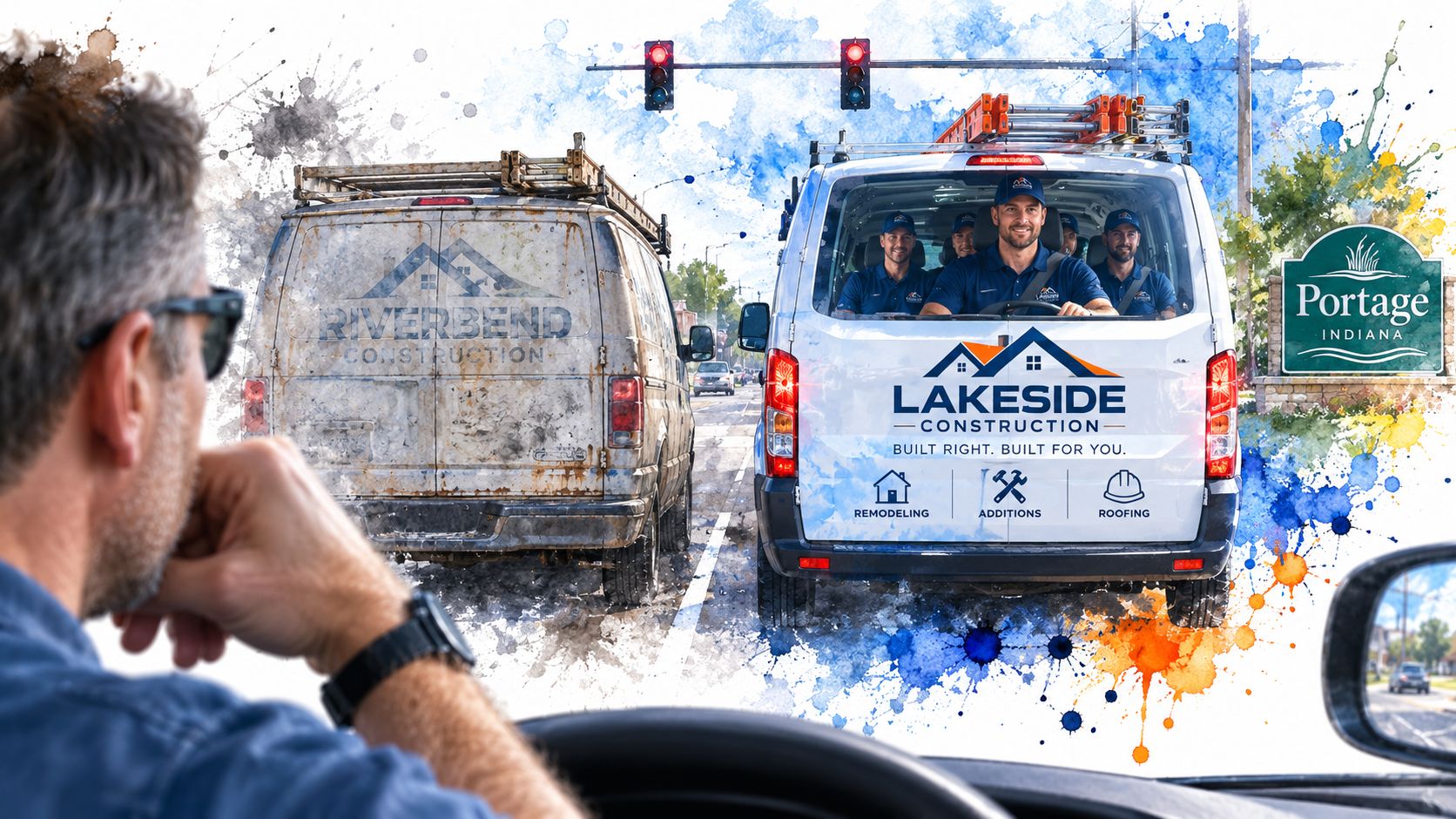
You're stopped at a light in Portage, watching two contractor vans roll through the intersection. One has a faded logo squeezed onto the door. The other has a clean vehicle graphic, matching polos, and technicians who look like they belong to the same company. Before either crew speaks, one business already feels more organized.
That's the practical power of custom apparel for small business. It isn't just a shirt with a logo. It can help an HVAC company look credible at a customer's home, give a salon a polished team presence, help a food truck sell an identity, or give a nonprofit a visible sense of community across Northwest Indiana and Chicagoland.
Why Custom Apparel Matters for Local Businesses
A customer often forms an opinion before the first conversation. They see your technician's shirt, your employee's polo, or your team's event gear and make a quick judgment about whether your business appears dependable.
For service companies, that judgment matters. An HVAC technician in a consistent branded shirt looks easier to identify and more prepared to work. A salon team in coordinated apparel feels intentional. A barber wearing a sharp embroidered shirt creates a stronger visual connection between personal style and business identity.
Branded clothing works in places your paid advertising doesn't. It appears at supply stores, coffee shops, festivals, school events, job sites, and neighborhood stops. The wearer doesn't need to explain the company every time someone sees the logo. The garment carries the introduction.
A strong identity system also makes apparel more useful. Your logo, colors, typography, and vehicle graphics should feel related, not randomly assembled. Review these small business brand identity principles before ordering so your shirts support the same recognition you're building on your website, signage, and vans.
Apparel by business type
The right role for apparel changes with the business:
HVAC contractors: Use durable work shirts, jackets, or polos that help customers identify technicians quickly.
Salons: Choose polished tops or jackets that support a clean, fashion-conscious atmosphere without making staff look identical.
Food trucks: Treat shirts as both uniforms and merchandise. Staff apparel should be easy to recognize, while customer-facing designs can carry more personality.
Barbershops: Lean into wearable style. A subtle chest logo or well-designed back graphic can turn customers into brand ambassadors.
Retail stores: Use apparel to make employees visible on the floor and reinforce the store's visual personality.
Nonprofits: Create event apparel that volunteers want to keep wearing after the fundraiser or community program ends.
The decorated and custom apparel market has already reached substantial scale, estimated at USD 28.98 billion in 2023, with projected compound annual growth of 12.9% from 2024 through 2030, according to industry market reporting. That growth creates room for local decorators and niche suppliers, but the opportunity still depends on making a smart business decision rather than ordering generic shirts.
Deciding Between Merchandise and Uniforms
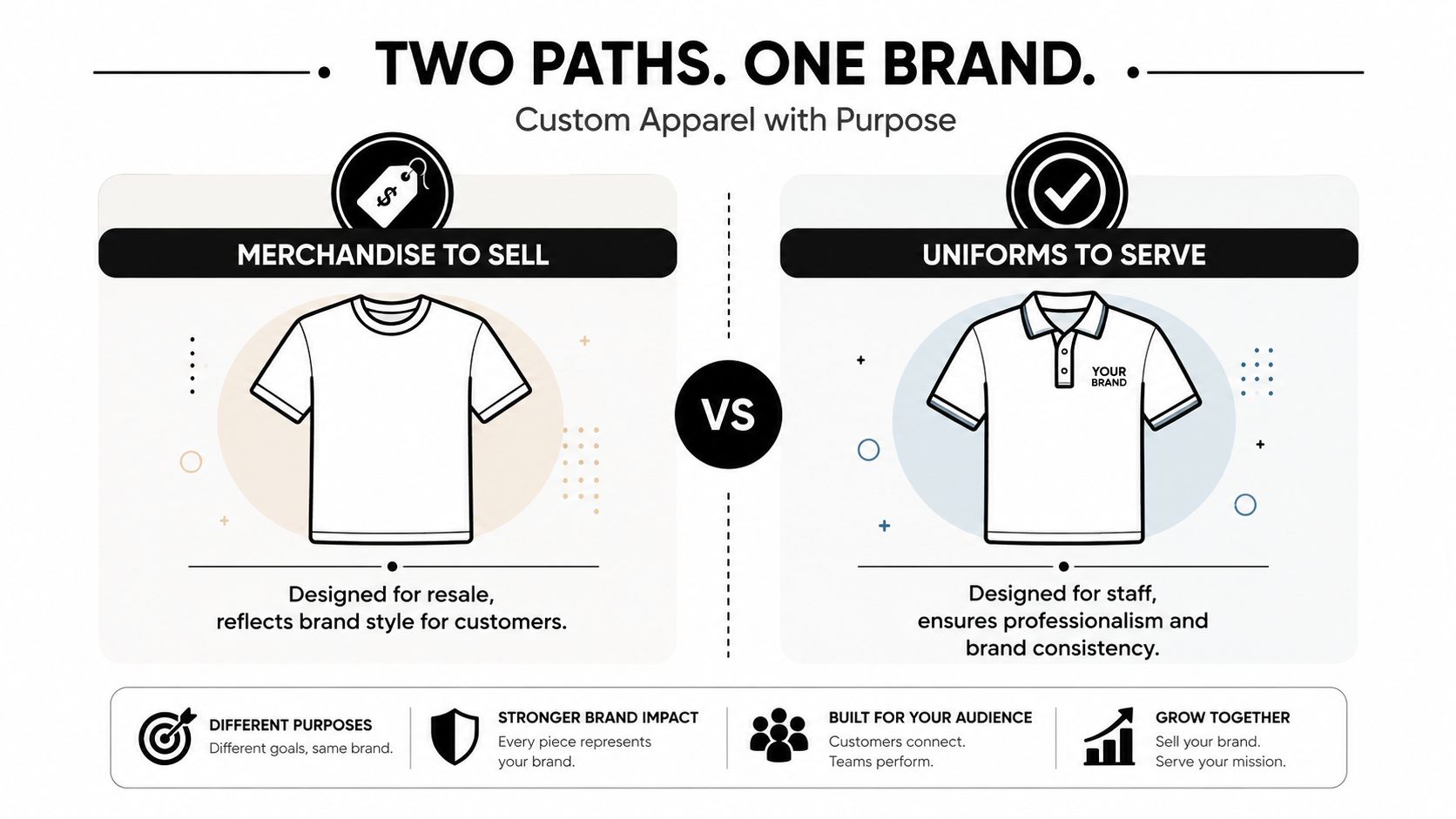
Start with one question: is the apparel supposed to sell, or is it supposed to serve?
Merchandise is a product. A food truck might sell a tee at a festival. A barbershop might display hats or shirts near the register. A retail store might release a limited design tied to a local event. The garment needs a style customers want, a price that supports the business, and a plan for avoiding unwanted inventory.
Uniforms are operational tools. They help customers identify staff, create visual consistency, and make a small team appear organized. An HVAC company may need practical shirts that survive field work. A salon may need coordinated polos or lightweight tops. A nonprofit may need volunteer apparel that makes event staff easy to find.
Merchandise to sell
Choose merchandise when customers already show interest in your brand, your location has steady foot traffic, or your business regularly attends festivals and community events.
Think beyond the logo. A food truck can create a design based on its signature menu item. A barbershop can use a clever phrase, vintage illustration, or neighborhood reference. A nonprofit can build a shirt around its mission instead of treating the organization's mark as the entire design.
The branded merchandise ideas guide can help you develop products that feel intentional rather than promotional.
Uniforms to serve
Choose uniforms when customers need to know who works for you, when employees visit homes or job sites, or when your team's appearance affects trust.
A uniform program should answer practical questions:
Who wears it: Separate needs for technicians, front-desk staff, stylists, drivers, and event volunteers.
Where it's worn: Indoor retail work has different fabric needs than outdoor service work.
How often it's reordered: Repeating the same garment and decoration keeps the team consistent.
What the customer should notice: Prioritize name visibility, company recognition, or a polished look.
Don't mix merchandise and uniforms casually. A staff shirt can be functional and still stylish, but a resale tee shouldn't be chosen only because it's inexpensive. Give each apparel category a job, then design and budget for that job.
Choosing the Right Fabric and Print Method
The decoration method should follow the garment, order size, artwork, and working conditions. A detailed comparison of screen printing and vinyl printing is useful when your design could work with more than one production approach.
Match the method to the order
Screen printing is the strongest choice for bold graphics and repeat orders where durability matters. One industry supplier states that screen printing can last through 100+ washes and recommends it for orders of 25 units or more, because screen setup costs of about $25–$35 per screen can make smaller runs uneconomical. See the screen printing business guidance for that benchmark.
Embroidery gives polos, jackets, hats, and button-downs a raised, professional finish. It suits salon teams, sales staff, property professionals, and contractors who want a more polished customer-facing uniform. Dense or highly detailed artwork may need to be simplified before stitching.
Direct-to-film works well for colorful artwork, gradients, and smaller custom runs. It can be a practical option when the design needs more detail than a simple spot-color print.
Print-on-demand keeps upfront commitment low. One guide estimates startup equipment at $0–$500, same-day launch potential, and typical profit of $4–$8 per shirt, while direct-to-film starter setups are estimated at $2,000–$5,000 with a 2–4 week ramp to a first order. These figures come from the custom apparel business study, and actual results depend on product choice, fulfillment, and sales activity.
Print method comparison for small business orders
Method | Minimum Order | Durability | Best For |
|---|---|---|---|
Screen printing | 25 units or more is commonly recommended | Can last through 100+ washes | Bold graphics, repeat orders, work shirts |
Embroidery | Depends on garment and design | Strong for polos, jackets, and hats | Professional uniforms and premium apparel |
Direct-to-film | Suitable for smaller runs | Depends on garment care and production | Detailed, colorful artwork |
Print-on-demand | Low upfront commitment | Depends on provider and garment | Testing merchandise without holding inventory |
For fabric, cotton offers familiar comfort and a natural feel. Blends can hold shape and balance comfort with everyday practicality. Performance materials make more sense for technicians, outdoor crews, food truck staff, and anyone working through humid summers or cold Northwest Indiana conditions.
Choose the shirt employees will tolerate during a full shift. A decoration method can't rescue a garment that feels hot, scratches, stains easily, or restricts movement.
Designing Apparel That People Actually Wear
The fastest way to waste an apparel budget is to make a shirt that looks like a billboard. A giant logo may be visible, but visibility alone doesn't make a garment desirable.
People keep and wear branded items when the item feels comfortable, looks intentional, and fits their normal wardrobe. A 2026 promotional-product study evaluated products using retention, visibility, usage frequency, and perceived value, emphasizing that strong branded apparel should be kept, used often, and valued by the person receiving it. The findings are summarized in promotional product marketing guidance.
Four design decisions that matter
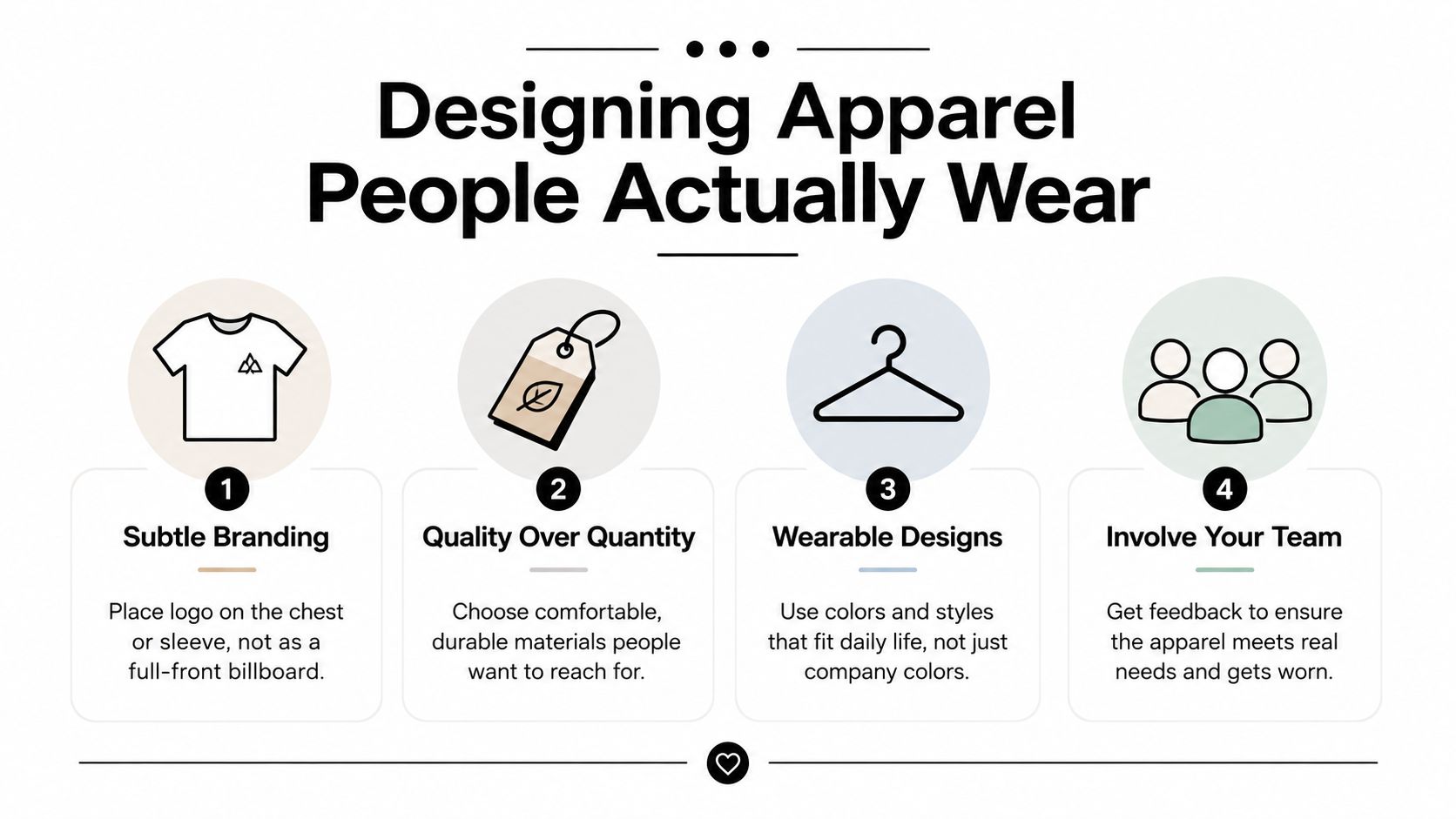
Keep branding controlled. A small left-chest mark, sleeve detail, or back-neck treatment often looks more wearable than a full-front logo. Contractors can add a larger back print when the company name needs to be visible from behind, but the front should still look clean.
Use contrast with purpose. A dark logo needs a lighter garment to remain readable, while a light mark needs a darker base. Don't choose shirt colors only because they appear in the brand guide. A white shirt may fit a salon, but a darker option may be more practical for an HVAC crew working around dust and equipment.
Respect typography. Small text, thin lines, and complicated taglines can disappear during production. Reduce the design until the company name, symbol, or core message reads quickly from a normal distance.
Ask the team before ordering. Employees know which fabrics feel comfortable, which colors show dirt, and which cuts work during a shift. Their input can prevent an expensive order that stays in boxes.
A salon might use a black or neutral top with a refined embroidered mark. An HVAC company might choose a durable performance shirt with a clear back identifier. A nonprofit could use an event design with a bold illustration and restrained logo placement.
Use color psychology in branding to make color choices intentional, but keep the final test simple: would someone wear this outside work? If the answer is no, revise the design before production.
Estimating Costs and Managing Order Quantities
Build the budget from the complete order, not a headline shirt price. Garment type, decoration method, artwork preparation, color count, quantity, personalization, packaging, and deadline can all change the quote. Ask the provider to separate garment, decoration, setup, delivery, and rush charges so you can see what drives the total.
Rush work needs a firm plan. A scheduled uniform reorder gives you time to confirm garments and production details. A last-minute trade show, food-truck event, or community program may require different sourcing and a faster approval process. Share the event date before approving artwork, then confirm that the garments can arrive on time.
Build the order around risk
For uniforms, match the purchase to each role and work setting. An HVAC technician working outdoors needs a different garment from an office receptionist. A barber may need a small, repeatable staff order, while a salon could separate employee uniforms from shirts sold to clients. For merchandise, start with the audience and expected demand. If interest is uncertain, avoid tying up cash in a large inventory run.
Tariffs, inflation, and supply uncertainty have made cost planning harder for decorated apparel businesses. In 2025 survey coverage, 55.1% of respondents cited tariffs inflating costs and disrupting supply chains, 55.1% cited persistent cost inflation, and 31.9% said they had limited ability to pass those increases to customers, according to the State of the Decorated Apparel Industry 2025 report.
Use that uncertainty to simplify reordering, not to panic-buy inventory. Select garments and decoration specifications that can be repeated, and keep a backup option for a hard-to-source style.
Practical rule: Approve the garment style, color, decoration method, and artwork as a repeatable system, not as a one-time purchase.
Use a simple purchasing framework
Test merchandise carefully: Release a limited design when demand is uncertain, then reorder the item that earns clear customer interest.
Standardize uniforms: Record the exact garment, color, decoration, and artwork specifications so repeat orders stay consistent.
Protect the deadline: Provide the event date before production begins. A quick design approval cannot solve a garment shortage.
Review the proof: Check logo proportions, placement, spelling, thread or ink colors, and sizing before production.
Plan replacements: Employees lose, stain, or outgrow garments. Keep the program simple enough to replace individual pieces without redesigning the full line.
The strongest budget decision is not always the lowest unit price. Choose the option that delivers dependable quality, practical reordering, and apparel people will use.
Working with a Local Apparel Provider in Northwest Indiana
A local provider can ask better questions because the work is close enough to discuss in practical terms. A Portage business may need apparel for humid summer events, muddy job sites, winter service calls, or a Chicagoland trade show. Those conditions affect fabric, decoration, timing, and quantity.
Small shops with 1–5 employees represent 75% of the U.S. garment decoration industry, according to industry data on custom apparel operations. That small-business structure makes clear communication especially important. Bring your logo files, preferred garments, staff roles, size list, deadline, decoration preferences, and examples of apparel you like.
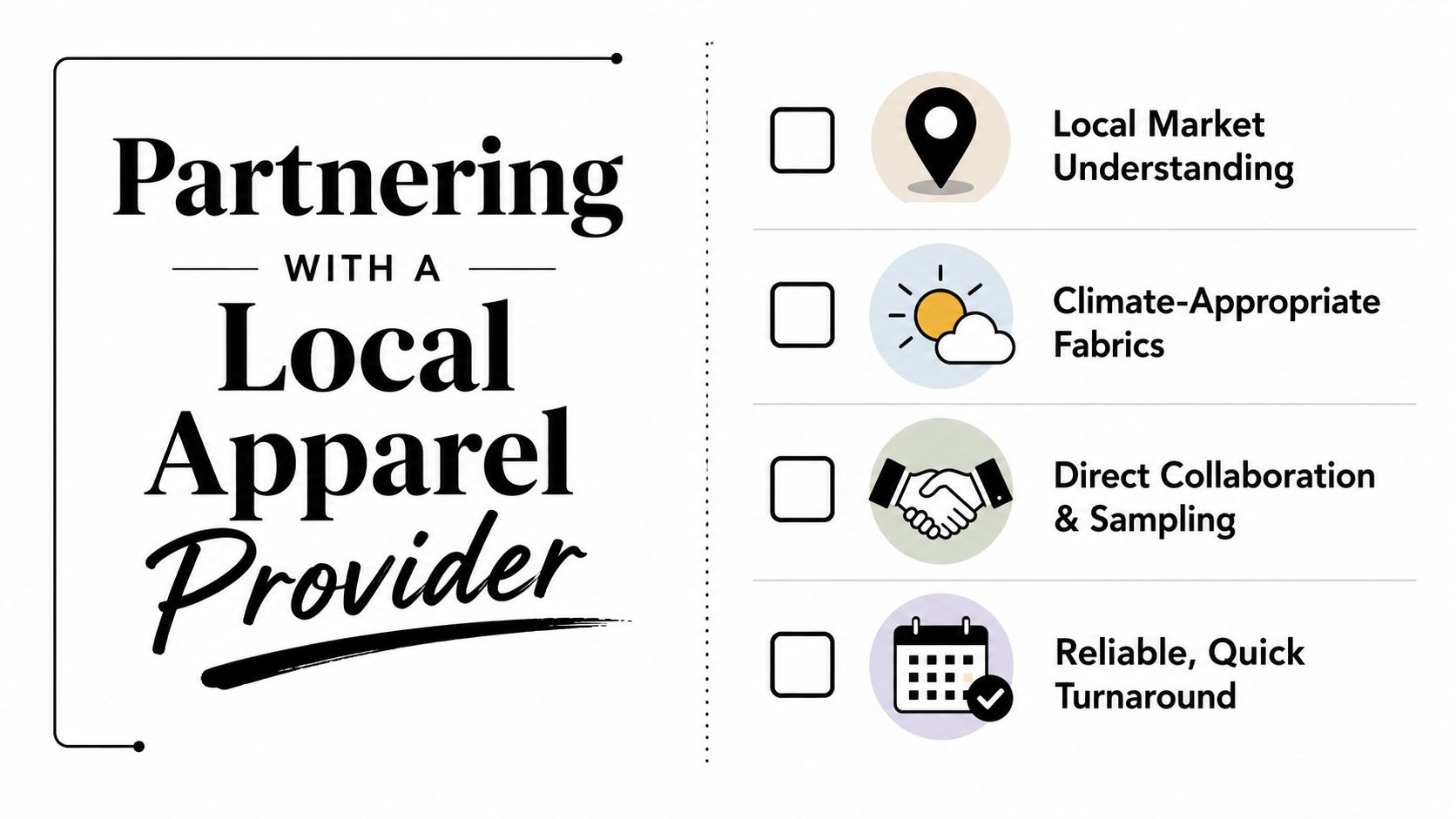
Ask how the provider handles proofs, samples, repeat orders, garment substitutions, and quality checks. Industry guidance identifies common checkpoints such as color consistency, placement accuracy, print or stitch quality, and finished-garment inspection. Frequent defects include registration drift, incorrect artwork versions, curing problems, and missed issues during packing, as outlined in apparel decoration benchmarking guidance.
The average custom apparel turnaround is estimated at 7 to 10 business days in recent industry reporting, so confirm the schedule before you announce an event or promise staff uniforms. Wash garments according to the provider's care instructions, avoid unnecessary heat when recommended, and store extra pieces in a clean, dry place.
Creative Graphic Solutions offers custom apparel design and production support, including help refining artwork and selecting decoration approaches such as screen printing and embroidery. Visit Creative Graphic Solutions to discuss branded uniforms, event merchandise, or a repeatable apparel program for your Northwest Indiana business, and call 219-764-1717 to request a quote.
Comments