
Market Research for Branding That Actually Moves the Needle
You've paid for the logo, booked the vehicle wrap, and approved a storefront sign. Then a customer in Portage asks a simple question your new tagline doesn't answer: “Do you handle emergency service?” That uncomfortable moment usually means the business guessed at its brand instead of checking what local customers need to understand, trust, and remember.
Market research for branding prevents that problem. It gives small businesses a practical way to test messages, discover local trust signals, and apply customer language to logos, wraps, signage, websites, and sales conversations. For contractors, salons, retailers, nonprofits, food trucks, and personal brands across Northwest Indiana and Chicagoland, the best research doesn't need to look like a corporate study. It needs to support a clear decision.
Why Smart Branding Starts With Real Research
A contractor can spend heavily on a redesigned identity and still miss the reason homeowners choose one service company over another. Maybe customers care less about a clever tagline and more about licensed technicians, clean work areas, clear arrival windows, or a familiar local presence. A polished logo can't repair a promise that doesn't match the buying experience.
That's why I treat research as the cheapest insurance against an expensive branding mistake. A few focused conversations can expose weak wording before it reaches a truck door. A short survey can show whether a color palette feels dependable or merely looks attractive to the owner. Observation can reveal that a sign is technically beautiful but unreadable from the road.
Practical rule: Never approve a major brand asset until you know what customers must understand within a quick glance.
Brand market research means systematically collecting and analyzing information about a brand, its competitors, and its target market to guide branding decisions, as explained in McKinsey's customer insights guidance. It helps answer questions such as:
Recognition: Do people know who you are?
Meaning: What do they associate with your business?
Credibility: Which proof points make you believable?
Choice: Why would they call, visit, or recommend you?
Experience: Does your actual service support the brand promise?
Brand trust deserves special attention. Edelman's 2019 Trust Barometer Special Report found that only 34% of consumers trusted most of the brands they buy or use, while 81% said trust was a deal breaker or deciding factor in purchase consideration. The report surveyed 16,000 people across eight countries, showing how research can quantify the gap between being recognized and being chosen. Those findings are summarized with the report reference in Edelman's brand credibility statistics overview.
For a Northwest Indiana business, the research question should be local and specific. Do homeowners trust a company because it feels nearby? Does a salon attract clients with warmth, technical expertise, or a distinctive style? Does a food truck need to emphasize menu personality, speed, or both? Brand awareness metrics can help, but awareness alone won't tell you why someone hesitates to buy.
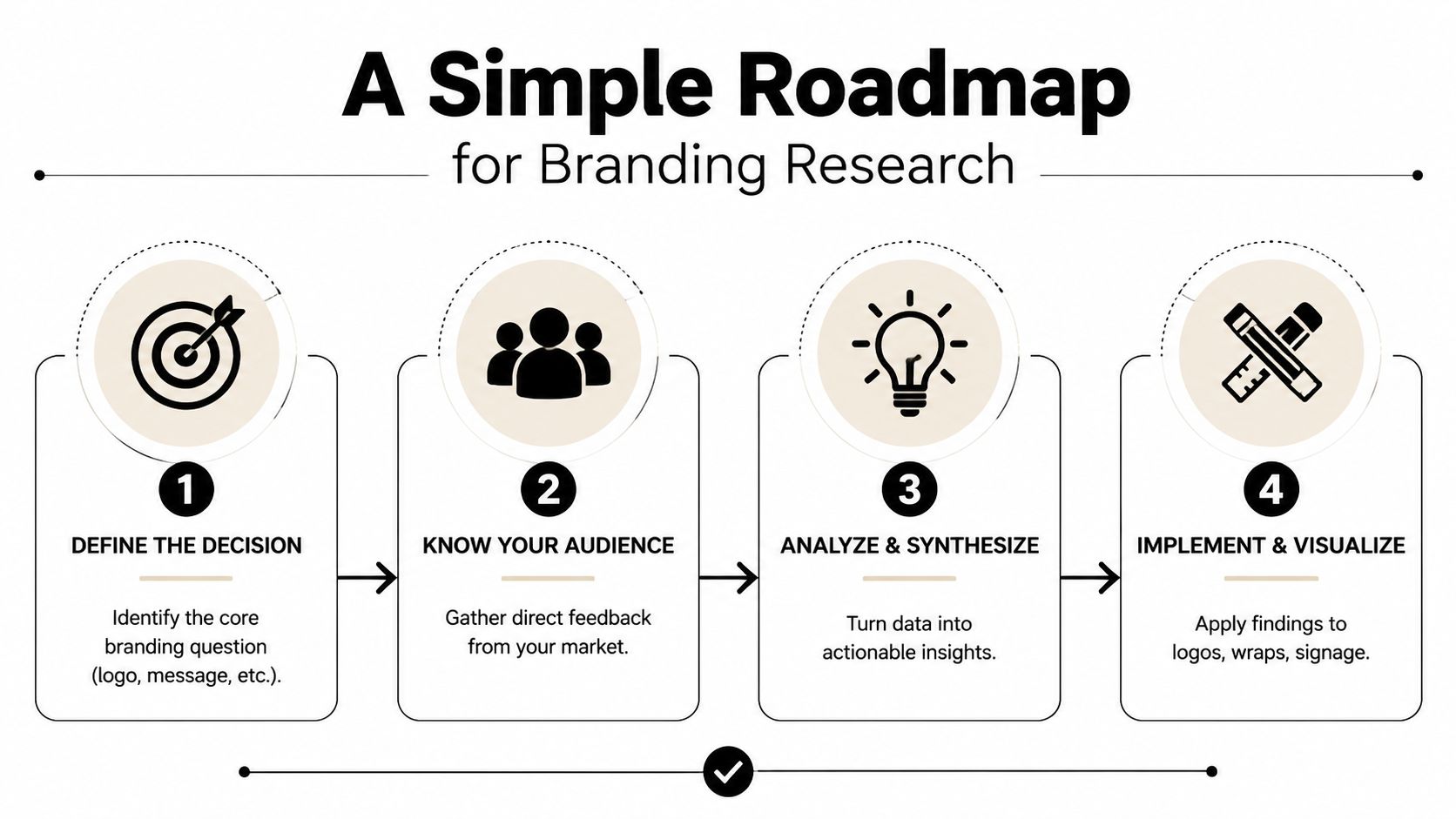
A Simple Roadmap for Branding Research
Branding research stays useful when each activity supports a decision. A contractor deciding between a more established or more approachable identity needs different evidence than a food truck testing whether its name reads clearly from the street. Set a stopping point before collecting feedback. A focused project can fit inside two to four weeks.
Step one defines the decision
Write one sentence describing what must change. “We need a new logo” leaves too much room for subjective opinions. Better questions include:
Should our identity feel more established or more approachable?
Does our vehicle wrap explain the service quickly?
Which message should lead the homepage and storefront sign?
What makes us different from nearby competitors?
A defined decision keeps research tied to action. It also gives the creative team a standard for judging feedback. Strategy should direct creative choices, so research findings can support decision-focused creative strategy rather than decorate a predetermined design.
Step two identifies the right people
Include more than favorite customers. Speak with:
Current customers: They can describe the experience they received.
Prospects: They can explain why they called a competitor or delayed.
Referral partners: Realtors, property managers, event organizers, and neighboring businesses often hear objections firsthand.
Former customers: Their reasons for leaving may reveal an operational issue that looks like a branding problem.
Group responses by geography when local identity matters. A customer in Portage may define “local” differently from a business serving the broader Chicagoland market. That distinction can affect wording, proof points, and the tone used on a vehicle wrap or sign.
Step three selects one or two methods
Match the method to the decision. A survey and competitor review may suit a logo refresh. Interviews and observation may fit a service business whose promise depends on the customer experience. Using every method creates more material than a small team can interpret.
Step four schedules the decision meeting
Set one meeting to review patterns, choose priorities, and assign asset changes. Stop collecting feedback when new responses no longer change the choice. The deliverable is a short list of verified brand actions, such as revising a headline, clarifying a service line, or changing the information hierarchy on signage.
Choosing the Right Research Methods for Your Business
Small businesses don't need every research method. They need the method that answers the question without consuming the time reserved for serving customers.
Method | Best For | Time Required | Typical Sample Size |
|---|---|---|---|
Customer survey | Quick checks on colors, taglines, clarity, and trust signals | Short launch and review cycle | Current customers and prospects |
One-on-one interviews | Customer language, motivations, objections, and service expectations | Focused conversations | A small group of relevant participants |
Competitor analysis | Positioning gaps, repeated visual codes, and local differentiation | Desk research and field review | A selected set of direct competitors |
Observational research | Sign readability, vehicle visibility, traffic flow, and real behavior | Scheduled field observation | Locations, routes, or customer interactions |
Surveys provide breadth
Use a survey when you need a quick signal check. Ask whether your service promise is clear, what words people associate with the business, and which proof points increase confidence. Avoid asking only whether someone “likes” a logo. Preference without context is weak evidence.
Interviews uncover useful language
A customer may never say “your positioning lacks differentiation.” They might say, “I called you because you were the only one who explained what would happen next.” That sentence can become better website copy than a room full of internal brainstorming.
Keep interviews conversational. Ask what happened before the purchase, what almost stopped the purchase, and what the customer expected after saying yes.
Competitor analysis reveals the visual crowd
Review local websites, yard signs, trucks, social profiles, uniforms, and storefronts. Look for patterns, not inspiration to copy. If every HVAC company uses the same blue flame icon and generic “quality service” language, that repetition is a clue that the category has visual sameness.
Observation catches behavior surveys miss
Stand near your sign. Ride along with a wrapped vehicle. Watch where people look, what they can read, and what they ignore. A survey respondent may say a sign looks professional, while real traffic never has enough time to read the phone number.
The strongest small-business combination is usually two methods, such as interviews plus observation or surveys plus competitor analysis. Watch for leading questions, a participant pool made only of friends, and conclusions based on politeness rather than behavior.
Sample Questions and a Survey Template You Can Use Today
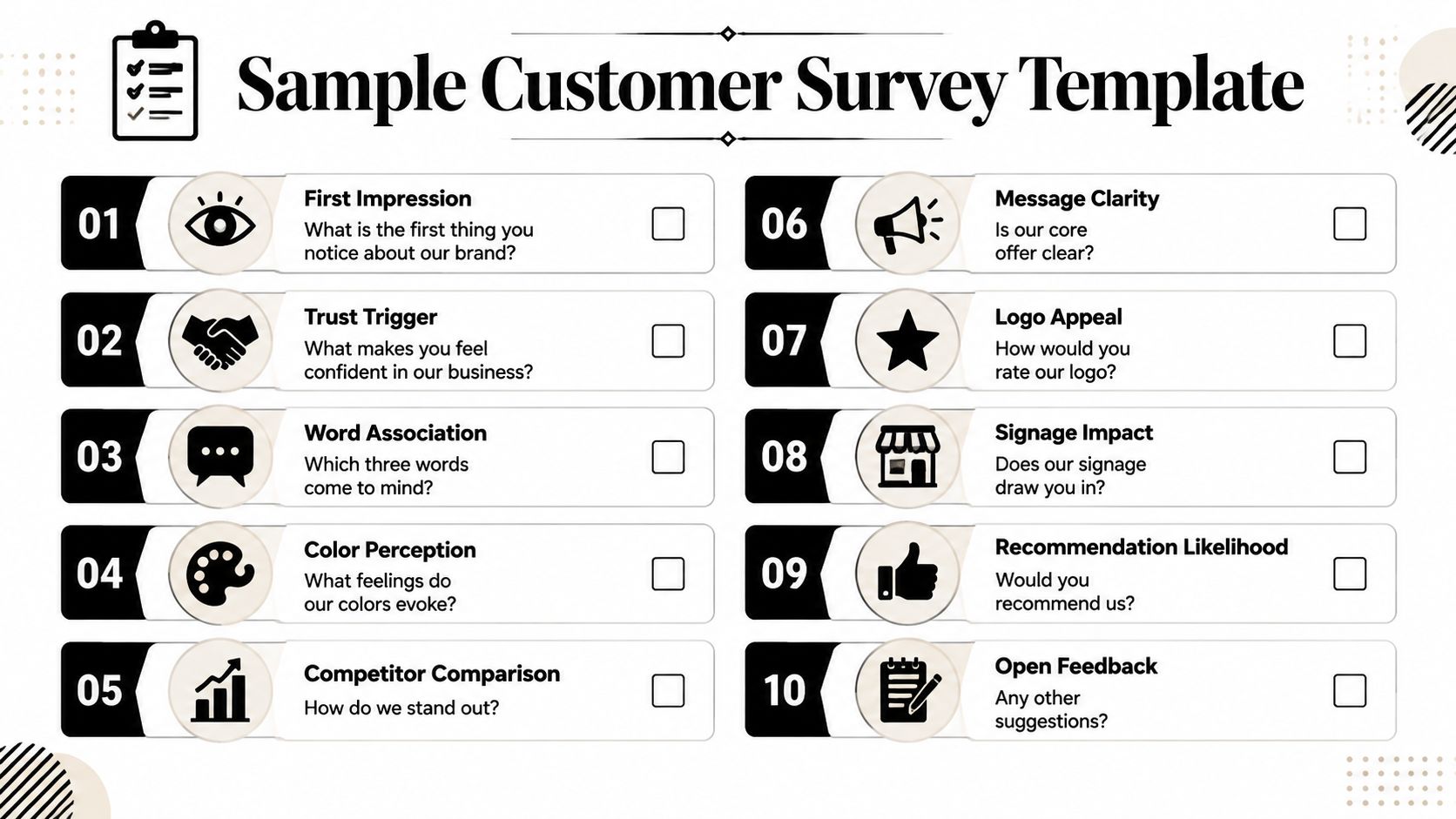
A useful survey asks customers to describe what they notice, trust, understand, and remember. It does not require them to act like brand strategists. For a contractor, salon, or food truck, those answers can reveal whether local customers recognize the business, understand its offer, and feel comfortable recommending it.
Build the form in Google Forms with one question per screen or section. Use one consistent rating scale, then finish with an optional open response. Keep personal information optional unless a specific follow-up requires it. Before writing questions, define the brand decision you need to make. Guidance on connecting research to creative choices is available in creative strategy guidance.
Copy-ready customer survey questions
What is the first thing you notice about our brand?
What makes you feel confident in our business?
Which three words come to mind when you think about us?
What feelings do our current colors create?
Compared with similar businesses, how do we stand out?
Is our main service or offer clear at a glance?
How well does our logo represent the business?
Does our signage make it easy to know where we are and what we do?
What would make you more likely to recommend us?
What is one thing you would change about our brand or customer experience?
Use response scales for clarity and confidence, then add an optional comment box. For the competitor question, include “not sure” so respondents do not invent an answer. If someone has not used your service, use skip logic to send them to questions about first impression and consideration.
Interview prompts and social polls
For interviews, ask:
What were you trying to solve when you contacted us?
What other options did you consider?
What nearly stopped you from choosing us?
What did we do that increased your confidence?
What would you tell a neighbor about our business?
A social-media poll should test one issue at a time. Ask whether a service truck should lead with “same-day appointments” or “careful, clean workmanship,” then ask why. The answer can guide wrap copy without treating a quick poll as final proof.
Invite respondents through receipts, email lists, direct messages, and ordinary customer conversations. A small local business can start with relevant customers instead of paying to reach a broad, unfocused audience. Define the question, budget, and time frame before collecting responses, as recommended by Bank of America's market research resource. Keep the survey short enough that customers finish it, and ask only questions tied to a real branding decision.
Turning Raw Data Into Real Brand Decisions
Raw responses don't become strategy automatically. First, sort them. Then interpret them against the decision you wrote at the start.
Use a three-pass review
Pass one, cluster recurring themes. Group comments under words such as trust, speed, value, expertise, cleanliness, local roots, convenience, or friendliness. Use the customer's language wherever possible.
Pass two, identify contradictions. Customers may describe your company as friendly but report that the phone experience feels difficult. They may praise your workmanship but struggle to understand the service list on your website. Those contradictions often point to an experience issue, not a logo issue.
Pass three, rank business impact. A preference matters less than a barrier to choice. If people love a color but can't tell what you do, clarity wins.
Market research is broader and more quantitative, while consumer insights are narrower and more qualitative. Bredin explains the distinction as market research answering “who” and “what,” while insights answer “why.” SurveyMonkey's consumer insights guide adds that insights translate motivations, barriers, perceptions, and behaviors into action.
Score themes without pretending the math is truth
Use a simple internal matrix to compare themes. Rate each from 1 to 5, then use the combined result to organize discussion. The score doesn't prove what customers will do. It helps a small team avoid choosing the loudest opinion in the room.
Research Theme | Trust Impact (1-5) | Local Relevance (1-5) | Differentiation (1-5) | Priority Score |
|---|---|---|---|---|
Clear arrival communication | ||||
Locally owned identity | ||||
Faster lunch service | ||||
Proof of workmanship |
A finding such as “customers associate us with reliability, not speed” should shape the tagline, headline, and wrap hierarchy. Don't promise speed because the owner wishes to compete on speed. If reliability is the lived strength, make that visible and improve scheduling separately.
Research should narrow the choices. It shouldn't turn every customer preference into a design requirement.
Document each decision in a shared file: finding, evidence, chosen action, rejected alternatives, and owner. An iterative design process works better when future staff can understand why the brand looks and sounds the way it does.
Applying Research Findings to Your Logo, Wraps, and Signage
Research earns its keep when it changes production files, not just meeting notes. One customer insight may shape the logo, vehicle, storefront, website, and printed materials in different ways, so assign each finding to the asset where it can do the most work.
Start with the most visible promise
If interviews show that customers value reliability, the identity might need sturdy typography, restrained language, and proof points such as years serving the area or clearly stated credentials. Keep detail out of the logo itself. The mark must remain identifiable at small sizes, while supporting copy carries the explanation. Logo design guidance for small businesses reinforces that a logo has a focused job, not the entire burden of explaining a company.
A Northwest Indiana contractor may learn that customers describe the business as careful, dependable, and easy to reach, while the existing identity resembles every other blue-and-white trade brand. The redesign could preserve category recognition while adding a distinctive accent, a clearer service descriptor, and local proof in the supporting copy. Research does not dictate a particular color. It identifies the perception the palette needs to support.
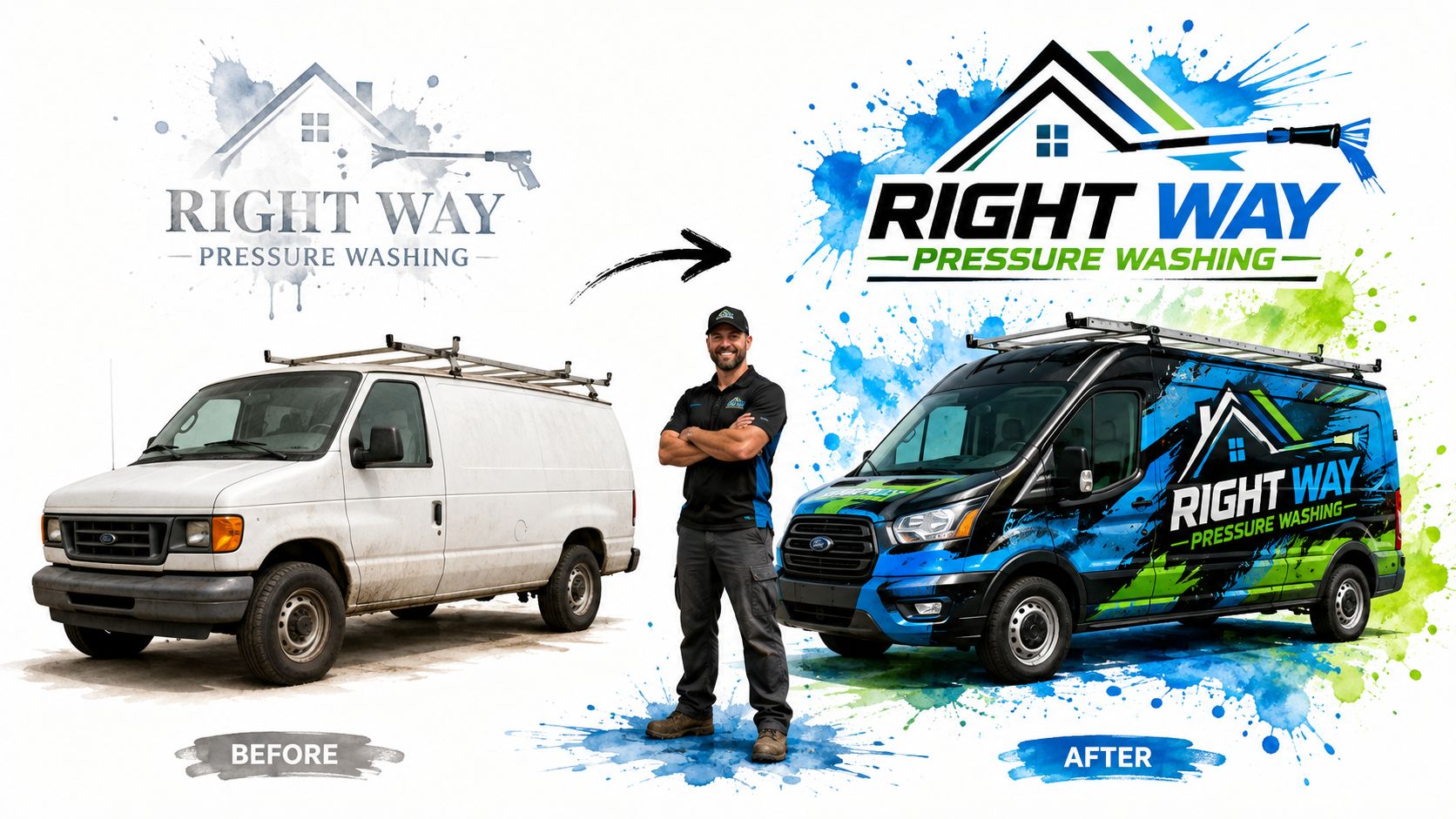
Translate findings into visible decisions through an iterative design process. Test the hierarchy, wording, and recognition before approving production. A preference in a survey is not automatically a design requirement. It must support local trust and the business's actual strengths.
Build a vehicle wrap for scanning
A moving vehicle gives people limited attention. Put the business name, service category, primary benefit, phone number, and service area into a clear hierarchy. Do not bury contact information beneath a giant graphic or a paragraph of copy.
For a food truck, interviews may reveal that lunchtime customers care about knowing what they can order quickly. The wrap should make the food category and ordering action obvious from a distance. Personality can remain in the menu styling, but the first message should answer what the truck serves and how a hungry customer starts.
Make storefront signage behave like a salesperson
A sign should identify the business before it tries to impress anyone. Test views from the sidewalk, parking lot, and passing lane. Check contrast, letter size, glare, nearby storefronts, and whether the name remains clear in poor weather or evening light.
Rank improvements by practical value:
Message clarity: Make the offer immediately understandable.
Contact action: Make calling, visiting, or ordering easy.
Vehicle and storefront consistency: Repeat the same name, colors, and promise.
Secondary materials: Update menus, apparel, flyers, and social graphics after the core system works.
Before production, give the designer and installer a short checklist:
What customer insight does each asset express?
Which message must remain unchanged?
Where should the eye land first?
Can the design work in one color and at small size?
Has the phone number, service area, and spelling been checked?
Does the installed asset match the approved hierarchy?
Your Branding Research Checklist and Next Steps
Treat the project as a focused sprint, not an open-ended branding exercise. A local business can make meaningful progress over two to three focused weekends when each task has an owner, deadline, and clear decision attached.
Print this working checklist
Define three brand objectives: Write what you need to learn or improve during the first work session.
Pick one primary research method: Choose surveys, interviews, competitor analysis, or observation based on the decision at hand.
Draft five customer questions: Finish the questions before contacting respondents.
Gather three competitor examples: Collect local trucks, signs, websites, menus, or social profiles for comparison.
Schedule two ride-along observation hours: Watch how people encounter your vehicle or storefront in real conditions.
Extract three insight statements: Link customer language to a specific business implication.
Update one brand asset per insight: Assign each finding to a logo detail, headline, wrap panel, sign, menu, or service process.
Set a deadline for every item. An open-ended survey lets the project drift. Treating every competitor example as a design reference can also make your brand look copied instead of useful and distinct.
Separate brand problems from service problems
Research may reveal requests for faster callbacks, cleaner job sites, clearer pricing, or better order communication. Those findings belong on an operations list. A new logo cannot repair a missed callback or inconsistent service, so connect the brand promise to what the team can deliver repeatedly.
Local trust deserves its own review. Edelman's 2025 Brand Trust report found that domestically headquartered brands outpace foreign brands by an average of 15 points globally, with gaps of 30 points in Germany and 29 points in Canada, as reported in Forrester's global trust coverage. For a Portage contractor, local salon, neighborhood retailer, nonprofit, or food truck, the practical question is whether neighborhood familiarity, regional experience, and visible community ties matter more than a polished identity that could belong anywhere. Test that question instead of claiming local ownership without proof.
Authenticity also needs measurement. A 2025 trust study reported that 97% of consumers say authenticity influences whether they support a brand and 70% are willing to pay more for authentic brands. It also identifies generic or robotic messaging, along with gaps between stated values and actions, as quick ways to lose trust. These findings appear in Clutch's brand authenticity survey. Ask whether customers respond to real people, local proof, transparent processes, and consistent service, especially when templated content makes competitors sound alike.
Turn findings into a usable brief
Use the research to write a one-page brand brief. Include the audience, strongest associations, trust barriers, chosen promise, visual direction, message priorities, and operational commitments. Then use an iterative design process to test the highest-impact choices before production. That document keeps a future designer, installer, or marketing hire from undoing the work.
Need help turning customer research into a clear logo, vehicle wrap, storefront sign, or messaging system? Visit Creative Graphic Solutions for strategic branding and design support serving Portage, Northwest Indiana, and Chicagoland, or call 219-764-1717 to discuss your next project and request a quote.
Comments