
How to Create a Brand Identity: A Practical Guide for Growing Your Business
Feel like your business is invisible? If you’re a contractor in Portage, Indiana, or a salon owner in Chicagoland, it’s a familiar feeling. You do great work, but in a crowded market, your message just isn't landing.
The answer isn’t just a slick new logo. It’s a complete brand identity—the entire experience a customer has with you, from your mission statement and the words you use to the colors on your work truck. Learning how to create a brand identity is your roadmap to building trust, earning loyalty, and becoming the only name people think of when they need your services.
Your Blueprint for an Unforgettable Brand
A strong brand identity cuts through the noise. It’s more than looking professional; it’s about creating a feeling and a promise that connects with your ideal customer on a gut level. It’s the difference between being a choice and being the choice.
This guide is your practical, no-fluff playbook for forging that connection. We’re skipping the high-level marketing jargon and getting straight to the actionable steps you can use right now. This isn't about theory; it's about getting real-world results for your small business.
The Power of Consistency
Think of your brand identity as your business’s DNA. It’s the code that ensures every single interaction—from your website to your work van to a simple flyer—feels cohesive and intentional.
And that consistency pays off, big time. Keeping your brand consistent can boost recognition by nearly 40%. Studies show companies that nail their identity across all channels see a significant lift in how well they’re remembered. For a local business in Northwest Indiana, that means more people recalling your name right when they need you. You can learn more about the impact of consistent branding.
“Brand identity captures the meaning and intent of the firm. It’s like a pair of tinted glasses that color how consumers understand, experience, and value a product or service.”
So, how do you build it? The process boils down to three core phases: figuring out your strategy, nailing your messaging, and then—and only then—designing your visuals.
Here’s a simple way to picture how those pieces fit together.
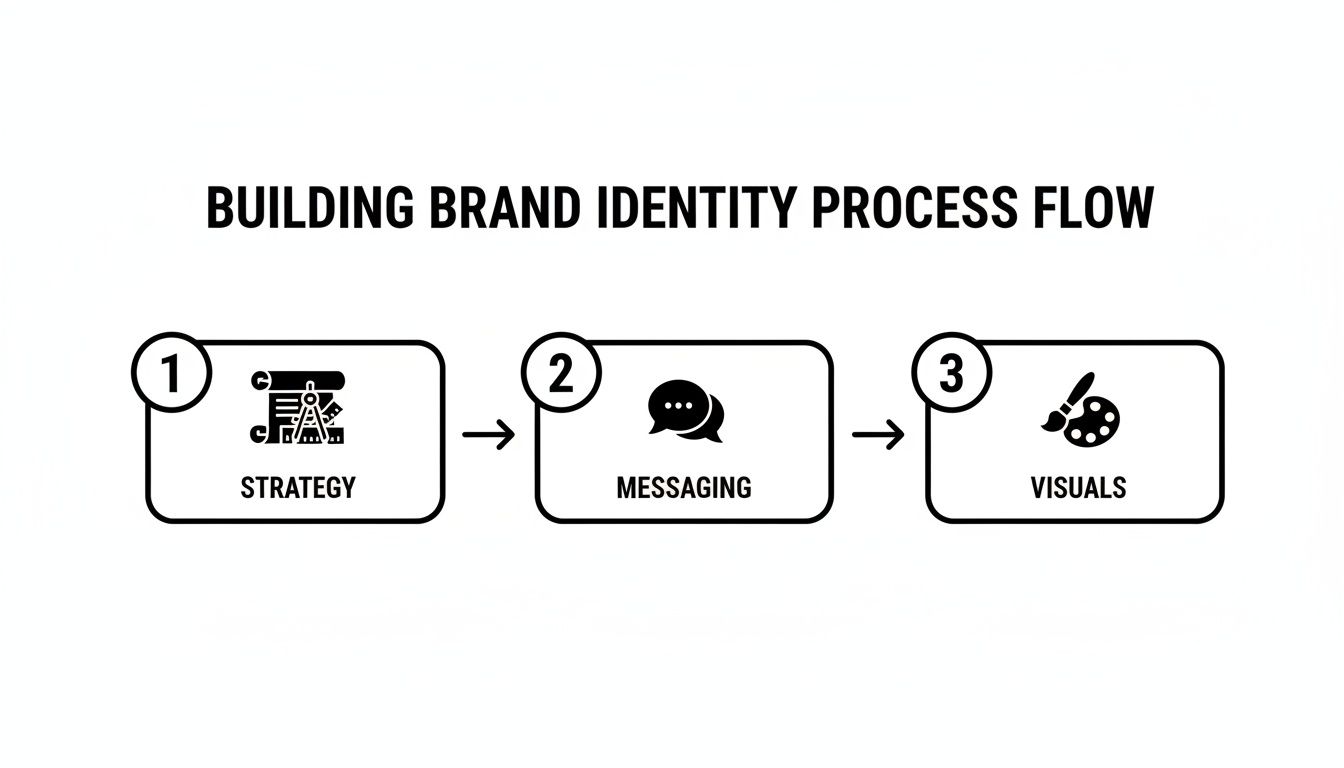
This shows you that a memorable look (the visuals) is always built on a solid foundation of what you stand for (your strategy) and what you say (your messaging).
At Creative Graphics Solutions, we've walked countless local businesses through this exact process. Now, we’re sharing that blueprint with you. And if you need a hand, just call us at 219-764-1717.
Building Your Foundation with Brand Strategy
It’s tempting to jump straight to the fun stuff—logos, colors, and flashy designs. I see it all the time. But that's a mistake. A powerful brand isn’t built on visuals; it’s built on a rock-solid foundation of strategy.
Honestly, this is the single most important part of creating a brand identity that actually works.
This is the deep work. It’s about figuring out who you are, who you’re talking to, and why it matters before you ever pick a font. Get this part right, and everything else falls into place much more easily.
Define Your Purpose, Mission, and Values
Before you can tell customers what you do, you have to know why you do it. Your purpose is the heartbeat of your brand. It’s the real reason you and your team get out of bed in the morning, beyond just making a profit.
Think about it: two landscaping companies in Northwest Indiana might both mow lawns. But one might exist to "create beautiful, stress-free outdoor spaces for busy families," while the other's mission is to "provide reliable, no-fuss property maintenance." That core purpose changes everything.
Your mission, vision, and values are the pillars holding this purpose up.
Mission Statement: This is what you do, who you do it for, and how you do it. Think of it as your purpose in a practical, grounded sentence.
Vision Statement: This is your big-picture dream. If you succeed beyond your wildest expectations, what change will you have created in the world (or just in Chicagoland)?
Core Values: These are the non-negotiable principles that guide every decision. Words like "Integrity," "Craftsmanship," or "Community" aren't just fluff—they're your brand's moral compass.
Pinpoint Your Ideal Customer
You can't be everything to everyone. Trying to appeal to the whole market is a surefire way to connect with no one. You have to get hyper-specific about who you're trying to reach.
Don’t just think "homeowners." Go deeper. Picture a specific HVAC client in Portage, Indiana. What’s her name? What does she do? What keeps her up at night—is it the fear of her furnace breaking in January, or is she more worried about energy efficiency?
A strong brand listens. People connect with brands that understand their needs, share their values, and solve a meaningful problem for them.
When you create a detailed customer persona, you stop marketing to a faceless crowd and start talking to a real person. This clarity will make every branding decision—from your messaging to your logo—infinitely easier.
Analyze Your Local Competition
You don’t operate in a vacuum. In a competitive market like Northwest Indiana, you need to know who you’re up against and, more importantly, how you’re different. A simple SWOT analysis is a killer tool for this.
Grab a piece of paper and split it into four boxes:
Strengths: What do you do better than anyone else? Is it your customer service, your unique process, or your deep community roots?
Weaknesses: Be honest. Where do your competitors have an edge? Is their pricing better? Do they have a bigger fleet of service trucks?
Opportunities: What market gaps can you fill? Is there an underserved neighborhood or a service no one else offers?
Threats: What outside factors could hurt your business? This could be a new competitor, changing regulations, or economic shifts.
This exercise isn't about copying what everyone else is doing. It’s about finding that open space in the market that only your brand can fill.
Craft a Unique Value Proposition
Once you understand your purpose, your customer, and your competition, you can finally put it all together. Your Unique Value Proposition (UVP)—sometimes called a Unique Selling Proposition (USP)—is a clear, punchy statement that tells people exactly why they should choose you.
It has to answer three questions:
How does your product or service solve your customer’s problem?
What specific benefits will they get?
Why should they buy from you and not the other guy?
Let's imagine a local food truck in the Chicagoland area. A weak UVP is, "We sell authentic tacos." A strong UVP hits different: "For busy downtown professionals, we're the only food truck serving authentic, gourmet tacos made with locally-sourced ingredients in under five minutes."
See the difference? The second one is specific, customer-focused, and highlights what makes them unique. This one statement becomes the strategic core of your entire brand identity.
If you ever need help clarifying your strategy, the team at Creative Graphics Solutions is just a phone call away at 219-764-1717.
Finding Your Voice Through Brand Messaging
Your brand strategy lays the groundwork—the "why" you exist and the "who" you serve. But brand messaging? That’s the "what" and "how." It's the verbal half of your identity: the words, tone, and stories that make people feel something. Killer visuals turn heads, but the right message builds a real connection.
If your visual identity is what people see, your messaging is what they hear. Let's get your brand talking.
What Is a Brand Voice?
Think of your brand voice as your company’s personality. It's not just what you say; it’s how you say it. Is your business the serious, buttoned-up expert or the friendly, approachable neighbor everyone trusts? Your voice sets the tone for every word you write.
A consistent voice makes your brand feel familiar and reliable. Imagine a Chicagoland contractor who sounds professional and knowledgeable on their website but fires off emails full of slang. That disconnect feels weird, and it breaks trust.
To start pinning down your voice, ask yourself these questions:
If my brand were a person, what three words would describe them? (e.g., Confident, Reliable, Straightforward)
What’s our relationship with our customers? (e.g., A trusted advisor, a helpful partner, an inspiring coach)
What tone do we absolutely want to avoid? (e.g., Stuffy corporate jargon, overly casual, arrogant)
Nailing down this personality first makes every other messaging decision a whole lot easier.
Developing Your Core Messaging Pillars
Once you’ve found your voice, it’s time to build your core messages. These are the foundational statements you'll use again and again—your brand’s greatest hits.
“Your customer value proposition should guide the creation of your brand identity, but it should also drive your brand stories.”
Your messaging pillars are the tangible expression of that value. They're the go-to phrases that instantly communicate who you are, what you do, and why it matters.
Here are the key pieces to lock down:
Tagline: A short, memorable phrase that captures your brand's essence. A Portage, Indiana-based plumber could go from a generic "Plumbing Services" to something with punch, like "Reliable Plumbing When You Need It Most." It’s a promise and a differentiator in one.
Key Messages: These are 2-3 core statements that are the backbone of your website copy, brochures, and sales pitches. For a local salon, a key message might be: "We provide expert hair care that helps busy professionals in Northwest Indiana feel confident and polished."
Elevator Pitch: This is your quick, 30-second summary of what you do. It needs to be clear, compelling, and delivered in your brand's unique voice.
These pillars make sure that no matter who is talking about your brand—a salesperson, a social media manager, or you—the core story stays the same. The power of storytelling in business is immense, and you can learn more about crafting compelling brand narratives in our related article.
Applying Your Voice Consistently
Defining your voice is only half the battle. The real work is applying it consistently everywhere your brand shows up. That’s how a message becomes a reputation.
Think about it. Your voice needs to be recognizable everywhere.
Where to Apply Your Brand Voice:
Digital Touchpoints | Physical & Interpersonal Touchpoints |
|---|---|
Website copy and blog posts | How you answer the phone at your office |
Social media captions | In-person sales conversations |
Email newsletters | Vehicle wrap text and signage |
Online advertisements | Employee uniforms and apparel |
Customer support chats | Voicemail greetings |
For example, if your brand voice is "helpful and friendly," your website should use plain English, not technical jargon. The way you answer the phone at your shop in Portage should be warm and welcoming. Every interaction reinforces who you are. This is what builds a brand people trust.
Need a hand finding the right words? We're experts at crafting messages that connect. Give Creative Graphics Solutions a call at 219-764-1717.
Crafting Your Visual Identity
Alright, this is where the magic happens. Everything you've defined so far—your strategy, your messaging, your brand's soul—is about to get a face. We're translating all those ideas into a look and feel that grabs attention and makes an instant connection.
A powerful visual identity is what makes a customer in Portage, Indiana, choose your work truck over the other guy's. It’s a shortcut to your brand's personality, communicating who you are before anyone reads a single word.
Let's break down the core elements.
Your Logo Is Your Brand's Signature
Your logo is the single most recognizable piece of your brand. It’s the handshake, the calling card, the face of your company. It will be everywhere—on business cards, your website, and splashed across the side of a food truck rolling through Chicagoland. A great logo isn't just a pretty picture; it's a strategic tool.
An effective logo needs to check a few boxes:
Simplicity: The best logos are clean and uncluttered. They need to be recognizable at a glance, whether on a giant billboard or a tiny social media icon.
Memorability: Does it stick in someone’s head? A unique, distinctive mark will always beat a generic template.
Versatility: A strong logo has to work everywhere. It needs to look just as sharp in black and white as it does in full color and scale up or down without losing clarity.
A local salon might go for a simple, elegant wordmark to communicate sophistication, while a plumbing contractor could use a bold icon that screams reliability. For a deeper look at what makes a logo tick, you can check out our guide on professional logo design.
Choosing Your Brand Color Palette
Color is pure emotion. The shades you pick have a huge psychological impact and can instantly set the tone for your brand. Think about the calming blue of a healthcare provider versus the energetic red of a fast-food joint. It's an instant vibe check.
This isn't just artsy theory; it's a powerful business tool. In fact, studies show a signature color can increase brand recognition by 80%. For your HVAC business or salon, a unified identity—logo, messaging, and colors—across your trucks, flyers, and social media is what drives customer decisions. You can discover more insights about branding statistics and ROI here.
When building your palette, aim for a balanced mix:
Primary Colors: One or two dominant colors that will be most associated with your brand.
Secondary Colors: Two to three complementary colors used for accents and highlights.
Neutral Colors: Shades like white, black, or grey for text and backgrounds to give the eyes a rest.
Let's wrap these core visual components into a simple table to keep things clear.
Core Components of a Visual Brand Identity
Here’s a quick rundown of the essential visual elements, what they do, and what you should consider as a small business owner.
| Visual Element | Purpose | Key Considerations | | :--- | :--- | | Logo | The primary identifier for your brand. It's your company's face. | Should be simple, memorable, and versatile enough for all applications. | | Color Palette | Sets the emotional tone and aids in brand recognition. | Choose a balanced mix of primary, secondary, and neutral colors. | | Typography | Conveys personality and ensures readability. | Select 2-3 distinct fonts. Create a clear hierarchy for headlines vs. body text. | | Imagery/Photography | Creates a consistent visual language and tells your brand's story. | Define a style: subject matter, composition, and color treatment. |
Getting these four pillars right is the foundation for a brand that not only looks professional but also feels authentic and connects with your ideal customers.
Demystifying Brand Typography
Typography—the fonts you use—is a subtle but critical piece of your brand's personality. It says a lot about you without saying a word. Are you modern and sleek, or traditional and trustworthy?
Don't just pick a font because it looks cool. Your type system has to be both on-brand and easy to read. A good rule of thumb is to stick to two or three fonts for your entire brand. Any more than that looks chaotic.
Your typography hierarchy should be crystal clear. Assign specific fonts and weights for different uses, like headlines, subheadings, and body text. This consistency makes your content easy for people to scan and read.
For example, a construction company might use a bold, sturdy sans-serif font for headlines to convey strength, paired with a clean, simple font for body text to keep proposals and websites legible.
Photography and Imagery Styles
The final piece of the puzzle is your approach to imagery. The photos, illustrations, and graphics you use should all feel like they belong to the same family. Are your brand photos bright, airy, and full of smiling people? Or are they gritty, industrial, and focused on the fine details of your craft?
Establish clear guidelines for your visual style. This should cover:
Subject Matter: What do you show in your photos? Your team at work? Your finished products? Happy customers enjoying your service?
Composition: Do your photos have a certain look, like a specific angle, a shallow depth of field, or a wide-open landscape shot?
Color Treatment: Are your images vibrant and saturated, or are they more muted? Applying a consistent filter or editing style helps tie everything together.
This consistent visual language ensures that every piece of content, from an Instagram post to a printed brochure, reinforces who you are.
At Creative Graphics Solutions, we specialize in weaving all these visual elements into a cohesive and powerful brand identity. Whether it's a business card or a full vehicle wrap, we make sure every piece works together seamlessly. Ready to bring your brand's vision to life? Give us a call at 219-764-1717.
Keeping Your Brand Consistent with Guidelines
You’ve done the hard work. You’ve brainstormed, strategized, and poured your heart into creating a killer brand identity. Now, how do you protect it?
A powerful brand is a consistent one. And consistency doesn't happen by accident, especially as your business grows. That's where brand guidelines come in—think of it as the official instruction manual for your brand.
Some call it a "brand bible" or a style guide. Whatever you call it, this document makes sure that every single person who touches your brand—from an employee in your Portage, Indiana office to a freelance marketer—gets it right every time. It’s a non-negotiable tool for scaling your business without diluting your identity.
What Goes into Your Brand Bible?
Don't panic. Your brand guidelines don't need to be a hundred-page novel. For most local businesses in Northwest Indiana, a simple, clear document covering the basics is all you need. The goal is to create rules that prevent brand confusion and save you time down the road.
Here’s what every good brand guide needs to include:
Logo Usage Rules: This is the big one. Show exactly how your logo can—and can’t—be used. Include clear examples of correct usage, minimum size requirements, and what not to do (like stretching it or changing the colors).
Official Color Codes: List your primary and secondary brand colors. This is critical: include the specific color values for both print (CMYK) and digital (RGB/Hex codes).
Typography Hierarchy: Nail down which fonts to use for headlines, subheadings, and body text. Specify the font names, weights (like Bold or Regular), and sizes so all your text looks clean and uniform.
Brand Voice Instructions: Briefly sum up your brand's personality. Are you professional and authoritative or friendly and casual? A few "say this, not that" examples can make this crystal clear.
A brand style guide is your single source of truth. It empowers your team and partners to apply your identity correctly, ensuring every customer touchpoint feels cohesive and intentional.
Think about it: you hire a new office manager or expand your salon to a second location. Instead of trying to explain your brand preferences over and over, you just hand them the guide. This document is your secret weapon for quality control.
Making Your Guidelines Stick
A style guide is useless if it just collects digital dust in a folder. The whole point is to make it an active, accessible tool for your entire team.
Keep it simple, visual, and easy to understand. The last thing you want is a guide filled with technical design jargon nobody gets. A great way to start is by creating a simple checklist of the essential visual and verbal rules that define your brand. This can become the foundation of your official guide.
Building a brand is a huge investment of time and money. Your brand guidelines are the insurance policy that protects that investment.
At Creative Graphics Solutions, we help businesses not only design their identity but also document it so it stays strong. If you need a hand creating a professional style guide that works, call us at 219-764-1717.
Launching and Managing Your New Brand Identity
You’ve done the heavy lifting. The strategy is set, the messaging is sharp, and the visuals are ready. Now it’s time to flip the switch. But launching a new brand identity isn’t a single event; it's a careful rollout across every place a customer might find you.
A smart launch makes sure that whether a customer is in Portage, Indiana, or anywhere else in Chicagoland, they experience your new brand as a cohesive, professional force from day one. It’s all about making that first impression count—every time.
A Phased Rollout for a Seamless Transition
Trying to update everything at once is a recipe for chaos. Slow down. Think in phases. A strategic rollout prevents you from feeling overwhelmed and ensures every piece gets the attention it deserves.
A solid game plan is to tackle your digital presence first, then move on to the physical stuff.
Here’s a simple way to break it down:
Phase 1: The Digital Foundation. Start with your website, all social media profiles (profile pics, banners, bios), and your email signatures. These are your most visible and easiest assets to update.
Phase 2: Core Physical Assets. Next up: the essentials you use every day, like business cards, letterhead, and any key in-store signage.
Phase 3: High-Impact Assets. This is for the big guns: vehicle wraps, large-scale outdoor signs, and employee uniforms. These require a bigger budget and more coordination, so saving them for last makes sense.
This methodical approach means you aren’t scrambling to update your work van’s wrap while your website still has the old logo. It's about staying in control.
Your Essential Brand Launch Checklist
A checklist is your best friend for turning a massive project into bite-sized tasks. Here’s a practical starting point for any local business, whether you’re a contractor or a retail shop.
Digital Asset Update Checklist:
Website: Swap out the logo, colors, fonts, and imagery.
Social Media: Change profile pictures, cover photos, and update bios.
Email Marketing: Refresh templates and update email signatures for the whole team.
Online Listings: Make sure your Google Business Profile and other local directories have the new branding.
Physical Asset Update Checklist:
Business Cards & Stationery: Design and print the new stuff.
Signage: Update storefront signs, A-frames, and any interior graphics.
Vehicle Wraps: A non-negotiable for any service business in Northwest Indiana.
Uniforms & Apparel: Get your team looking sharp with branded shirts or hats.
Marketing Collateral: Update brochures, flyers, and sales presentations.
Working with a local expert makes this process a million times smoother. When you need a partner who gets the difference between a quick print job and a real brand rollout, exploring why hiring a local studio matters can be a total game-changer.
Measuring the Impact of Your New Identity
So, how do you know if the new brand is actually working? You measure it. Your brand identity isn't just about looking good; it's a business tool designed to get results. After the launch, keep an eye on a few key metrics.
Brand value is a real economic driver. Strong brands see better customer loyalty, higher engagement, and ultimately, more growth. This is especially true online, where 77% of consumers would rather buy from brands they follow on social media.
A clear, consistent brand helps you earn that loyalty.
Your brand is a living asset. Monitor its performance, listen to what people are saying, and be ready to make small tweaks. The goal isn't just to launch strong but to build an identity that grows with your business.
Look for shifts in these areas:
Website Traffic: Are more people finding you? Are they sticking around longer?
Social Media Engagement: Are you seeing more likes, comments, and shares?
Customer Feedback: What are people saying? Are they noticing the new look?
Lead Quality: Are you attracting more of the right customers?
Launching and managing your identity is the final, crucial step in learning how to create a brand identity that doesn't just look pretty—it actively works for your business.
Ready to build a brand that captivates customers and grows your business? Creative Graphics Solutions is your local expert for a professional and consistent brand rollout, from design to the final vehicle wrap. Call us at 219-764-1717 or request a free quote today.
Crafted with Outrank tool
Comments