
How to Rebrand Your Business: A Practical Guide for Northwest Indiana
Let’s be real: deciding to rebrand feels like a huge, scary leap. But it’s not a white flag of surrender. Think of it as a calculated power move—a chance to make sure your brand’s look, feel, and message are actually pulling their weight for your business today, right here in Chicagoland.
Why a Rebrand Is More Than a New Logo
That little voice in your head whispering that your brand just doesn't fit anymore? That's your gut, and it's usually right. For business owners all over Northwest Indiana, that feeling often points to something bigger.
Maybe your contracting business in Portage, Indiana, has grown beyond its "one-man-and-a-van" origins. Maybe your salon’s vibe feels more 2012 than 2024. Or maybe you're a food truck owner who keeps attracting customers looking for something you don't even sell.
Thinking about how to rebrand your business is a proactive step toward a stronger future. It’s not just for the big guys, either. A wild statistic shows that 74% of S&P 100 companies have rebranded within their first seven years. If the giants are doing it, it proves that refreshing your brand early and strategically gives you a serious leg up. You can dig into more of these rebranding campaign statistics and see how this plays out for businesses of all sizes.
The Real Triggers for a Rebrand
So, what are the actual signs that it’s time for a change? It’s rarely just one thing. It's usually a slow burn—a handful of problems that pile up until you can't ignore them anymore.
Here are the most common triggers we see at Creative Graphics Solutions:
Your Business Has Evolved: You started out as a solo contractor, but now you’ve got a full crew and a fleet of vans. Your services have expanded, or your mission is just plain different. Your brand needs to catch up to who you are now, not who you were five years ago.
You're Attracting the Wrong Audience: If you're constantly on the phone with customers who aren't a good fit, your brand is sending the wrong signals. A rebrand helps you speak directly to the people you actually want to serve.
Your Visuals Look Dated: Design trends move fast. A logo that looked sharp in 2015 can scream "out of touch" today. That outdated look can make potential customers in Northwest Indiana second-guess your credibility before they even pick up the phone.
The Market Has Shifted: New competitors are popping up, your customers expect different things, or your whole industry has changed. A rebrand helps you stake your claim and show everyone why you're still the best choice.
Sometimes, you're not sure if you need a total overhaul or just a minor tune-up. This quick checklist can help you figure out where you stand.
Rebrand or Refresh: Key Indicators for Your Business
Use this quick checklist to self-assess if a strategic rebrand is the right move for your Portage-based business.
Symptom in Your Business | What It Signals | Potential Rebrand Action |
|---|---|---|
Your logo feels old-fashioned or was a DIY job. | Visual identity is outdated and lacks professionalism. | Visual Identity Refresh: Update the logo, color palette, and fonts. |
You’ve added major new services or products. | Your brand messaging no longer reflects your full value. | Positioning & Messaging Overhaul: Redefine your mission and core messages. |
Your top competitor just did a major rebrand. | You risk looking stale or falling behind in the market. | Competitive Repositioning: Differentiate your brand to stand out again. |
You're trying to attract a new type of customer. | Your current brand may not resonate with the new target audience. | Full Rebrand: Rethink strategy, messaging, and visuals for the new demographic. |
Your company name is limiting or confusing. | The name itself is a barrier to growth or clarity. | Full Rebrand with Name Change: The most intensive option for a total reset. |
You're embarrassed to hand out your business card. | You’ve lost confidence in your own brand identity. | Visual Identity Overhaul: Create visuals that you’re proud to show off. |
This isn't an exact science, but if you're nodding along to more than a couple of these, it’s probably time to have a serious conversation about your brand's future.
A rebrand is your chance to tell a new story—one that’s authentic, compelling, and perfectly aligned with where your business is headed. It’s about turning that feeling of uncertainty into a powerful new beginning.
This guide is your practical, no-fluff roadmap for that journey. We’ll walk you through the three core phases—strategy, identity, and rollout—so you can tackle this thing with total confidence. If you get stuck or just want to talk it through, give us a call at 219-764-1717.
Building Your Rebrand on a Solid Foundation
Jumping straight into designing a new logo without doing the groundwork is like building a house without a blueprint. Sure, it might look okay for a minute, but it won’t stand the test of time. A rebrand that actually works starts with a deep, honest look at your business—what we call a brand audit.
This isn’t just marketing fluff; it’s the strategic heart of the entire process. It's where you get brutally honest about what’s working, what isn’t, and where you actually want to go. Trust us, skipping this step is the number one reason rebranding efforts fail.
Uncovering Your Brand’s Truth
Think of a brand audit as a health check-up for your business's identity. It’s all about digging into every single aspect of your brand to figure out where you stand in the market and how you’re seen by the people who matter most—your customers.
You’re hunting for the gaps between how you see your brand and how your customers actually experience it. Those gaps? That’s where your biggest opportunities are hiding. In fact, some research suggests a staggering 70% of rebranding efforts crash and burn without a solid strategy and brand audit. That should be a massive red flag for any business owner thinking about a change, whether you're a local business in Portage or run a shop in Chicagoland.
This audit is your insurance policy. It stops you from making costly mistakes and makes sure your new brand is built on data and real insight, not just a gut feeling.
Key Areas to Investigate in Your Audit
So, where do you start digging? A proper brand audit isn't a one-afternoon task. It means looking inward at your company and outward at your market.
Look in the Mirror: Internal Brand Health
First, you have to look inward. Get your team involved and start asking the tough questions about who you are.
Mission, Vision, and Values: Are they still relevant? Does your team even know what they are? Your mission should be your North Star, guiding every decision. If it’s just a plaque on the wall, it’s not working.
Company Culture: Does your internal vibe match the brand you want to show the world? Your employees are your first and most important brand ambassadors. If they aren't on board, your rebrand will feel fake from day one.
Brand Voice and Messaging: Pull up your website copy, social media posts, and sales scripts. Is the tone consistent? Does it actually connect with your ideal customer, or does it sound like generic corporate jargon?
Look Out the Window: External Brand Perception
Now, it’s time to see how the outside world sees you. This is where you have to step out of your own shoes and get some unbiased feedback.
Customer Surveys and Interviews: This is non-negotiable. Talk to your best customers. Find out why they chose you over everyone else. Ask them to describe your brand in three words. You might be shocked by what you hear.
Online Reviews and Social Media: What are people really saying about you on Google, Yelp, and Facebook? This is a goldmine of raw, unfiltered feedback about your customer experience.
Website Analytics: Where are people finding you? What pages do they look at? Where do they give up and leave? Your website data tells a story about whether your message is landing or falling flat.
Your brand isn’t what you say it is. It’s what your customers say it is. The brand audit is your chance to really listen to them, maybe for the first time.
Size Up the Competition
No brand exists in a vacuum, especially not in the competitive Northwest Indiana market. You have to know who you’re up against and where you fit in. This isn’t about copying your competitors; it’s about finding a unique space you can own.
Fire up a simple spreadsheet and track your top 3-5 local competitors. Analyze their:
Visuals: What do their logos, websites, and vehicle wraps look like? Are they modern and professional, or do they look dated and cheap?
Messaging: What promises are they making? What are their main selling points?
Market Position: Are they the budget option, the high-end expert, or the friendly neighborhood go-to?
This analysis will show you where the opportunities are. If every other contractor in the area is using loud, aggressive branding, maybe a clean, trustworthy, and professional look is your ticket to standing out. This is a critical part of a successful rebrand, as it informs every decision you’ll make moving forward. For a deeper dive into this initial phase, check out our guide on how to develop a brand strategy that wins more customers.
At Creative Graphics Solutions, we guide businesses through this entire audit process. We help you collect the data, make sense of it all, and turn those insights into a powerful strategy. Need an expert eye? Give us a call at 219-764-1717.
Crafting Your New Visuals and Voice
Alright, you’ve done the hard work—the soul-searching, the spreadsheets, the strategy sessions. Now for the fun part. This is where your rebrand stops being a bunch of ideas on a whiteboard and starts feeling real. We're talking about the tangible stuff people will see, hear, and feel.
This is where consistency becomes your best friend. From a contractor's truck wrap cruising down I-65 to a salon's Instagram stories in Portage, Indiana, every single piece needs to sing the same tune. It's not about just grabbing a cool font or a color that’s trending; it's about turning your strategy into a vibe that your ideal customer instantly gets.
Designing Your Visual Identity
Think of your visual identity as your brand's wardrobe. It’s the collection of design elements that people will immediately recognize as you. It needs to fit perfectly and make the right first impression, every single time.
Here's what goes into that wardrobe:
Logo Design: This is the cornerstone, your brand's handshake. A killer logo is simple, memorable, and works everywhere—looking just as sharp on a tiny business card as it does blown up on a massive sign.
Color Palette: Colors aren't just for decoration; they're packed with psychological shortcuts. For an HVAC company in Northwest Indiana, a palette of blues and grays screams trust and reliability. A local food truck? They’ll probably go with bright, energetic oranges and yellows to signal fun and flavor.
Typography: The fonts you pick say a ton about your personality. A clean, modern sans-serif font might be perfect for a tech-savvy contractor, while an elegant serif font feels just right for a high-end barbershop. The trick is to find fonts that are both on-brand and easy to read.
Imagery & Photography: Are you a "professional headshots of the team on the job" kind of brand, or more of a "stylized, lifestyle photos" brand? The images you choose set the tone and help customers picture themselves using your service.
Here’s the thing: these elements have to show up consistently everywhere. This is where so many businesses fumble. If your website uses one set of colors and your vehicle wraps use another, you’re just confusing people and watering down your brand’s power.
The goal is instant recognition. When a potential customer sees your colors, font, or logo, they should immediately think of your business—and know exactly what you stand for.
Finding Your Brand Voice
If your visuals are the face, your brand voice is the personality. It’s not just what you say, but how you say it. A solid brand voice makes you sound like a real person, not some faceless corporate robot, which is everything when you're trying to connect with customers in the Chicagoland area.
Think about a local business owner. Their brand voice might be chic, friendly, and empowering. You’d see it in their website copy and social media captions, using words that make clients feel confident and ready to take on the world.
Now, picture a contractor. Their voice is probably more straightforward, knowledgeable, and reliable. They cut the jargon and speak in clear, direct terms that build trust and prove they know their stuff.
Developing Your Voice
Not sure what your brand sounds like? Start by asking these questions:
If my brand were a person, what three words describe it? (e.g., Confident, helpful, witty)
What's my relationship with my customers? (e.g., A trusted advisor, a friendly neighbor, an expert guide)
What kind of language does my ideal customer use? (e.g., Casual and conversational, or more professional and technical?)
Once you’ve got those answers, you can start building out your core messages, defining what makes you different, and maybe even creating a tagline that sums it all up. Your tone might shift a little—more casual on social media, more formal in a proposal—but that core personality should always be there.
Bringing It All Together in Brand Guidelines
So, how do you make sure everyone on your team—plus any freelancer or agency you hire—gets it right every time? You build a brand style guide.
This document is your brand’s rulebook. It's the one-stop shop that details every single part of your new identity. We're huge on this at Creative Graphics Solutions because we’ve seen what happens without one: brand chaos. For a deep dive, you can learn how to create brand guidelines for your small business in our detailed guide.
Your brand guide should absolutely include:
Logo Usage: Clear do's and don'ts. Show minimum sizes, clear space requirements, and examples of what not to do (don't stretch it, don't change the colors!).
Color Palette: Your primary and secondary colors with their specific codes (HEX, CMYK, RGB) so they look the same online and in print.
Typography Rules: The specific fonts for headlines, body text, and everything in between, including size and spacing rules.
Voice & Tone Guidelines: Describe your brand's personality, give examples of on-brand copy, and list some words to use (and a few to avoid).
This guide is your secret weapon for a smooth rollout. It ensures that whether you're ordering new business cards, updating your website, or wrapping a new company vehicle, your brand will always look and sound exactly like it should.
If turning all this strategy into a killer visual and verbal identity feels like a heavy lift, give our team at Creative Graphics Solutions a call at 219-764-1717. We live for this stuff.
Launching Your New Brand with Confidence
You’ve done the hard work. The strategy is sharp, the visuals are killer, and the messaging is on point. But a brilliant rebrand can absolutely fizzle out if the launch is a mess. All that effort deserves a grand entrance, not a quiet stumble into the market.
This is where you build a rollout plan that makes your new identity impossible to miss. It’s about making the transition smooth, exciting, and totally seamless for everyone involved—from your internal team to your most loyal customers.
Your Internal Launch Comes First
Before you tell the world, you have to tell your team. They’re your number one brand ambassadors. If they’re confused or caught off guard, that uncertainty will leak out to your customers. An internal launch isn’t just a memo; it’s a rally.
Get them excited! Walk them through the "why" behind the rebrand—the customer insights, the new direction, the big vision. When your team understands the story, they can tell it with genuine enthusiasm.
Phasing Your External Rollout
A killer launch is all about timing and consistency. You can’t have new vehicle wraps on the road while your old logo is still splashed all over your website. This is where a phased timeline is your best friend.
Let's imagine a local Northwest Indiana contracting business. Their rebrand is designed to feel more professional and community-focused. Their rollout plan might look something like this:
Phase 1 (The Digital Flip): This happens all at once. On launch day, the new website goes live, all social media profiles (Facebook, Instagram) get updated with the new logo and banners, and a beautifully crafted email goes out to their entire list of customers and prospects.
Phase 2 (Physical Assets): Over the next week, they roll out new physical materials. This means new business cards and letterhead for the staff, updated brochures for sales calls, and fresh signage at their Portage office.
Phase 3 (Major Visibility): The big-ticket items come last. They could unveil a newly wrapped fleet of vans at a local business expo or partner with other Chicagoland businesses for a launch event.
This approach prevents confusion and builds momentum. Each new element reinforces the change, creating a sense of excitement instead of chaos.
The Nitty-Gritty Details of the Launch
The sheer number of things to update can feel totally overwhelming. It's a game-changer to realize that, according to a Bynder rebranding report, a staggering 82% of marketers have worked on a rebrand. The study also found that a company has to update around 215 different marketing assets on average. No wonder the rollout is often the toughest part.
To keep your sanity and avoid missing anything, a detailed checklist is non-negotiable.
The moment your new brand goes public, the old one must disappear completely. Consistency from day one is critical. It shows confidence and makes your new identity feel intentional, not accidental.
The visual process for creating this new identity—from logo to voice—is the foundation for the launch itself.
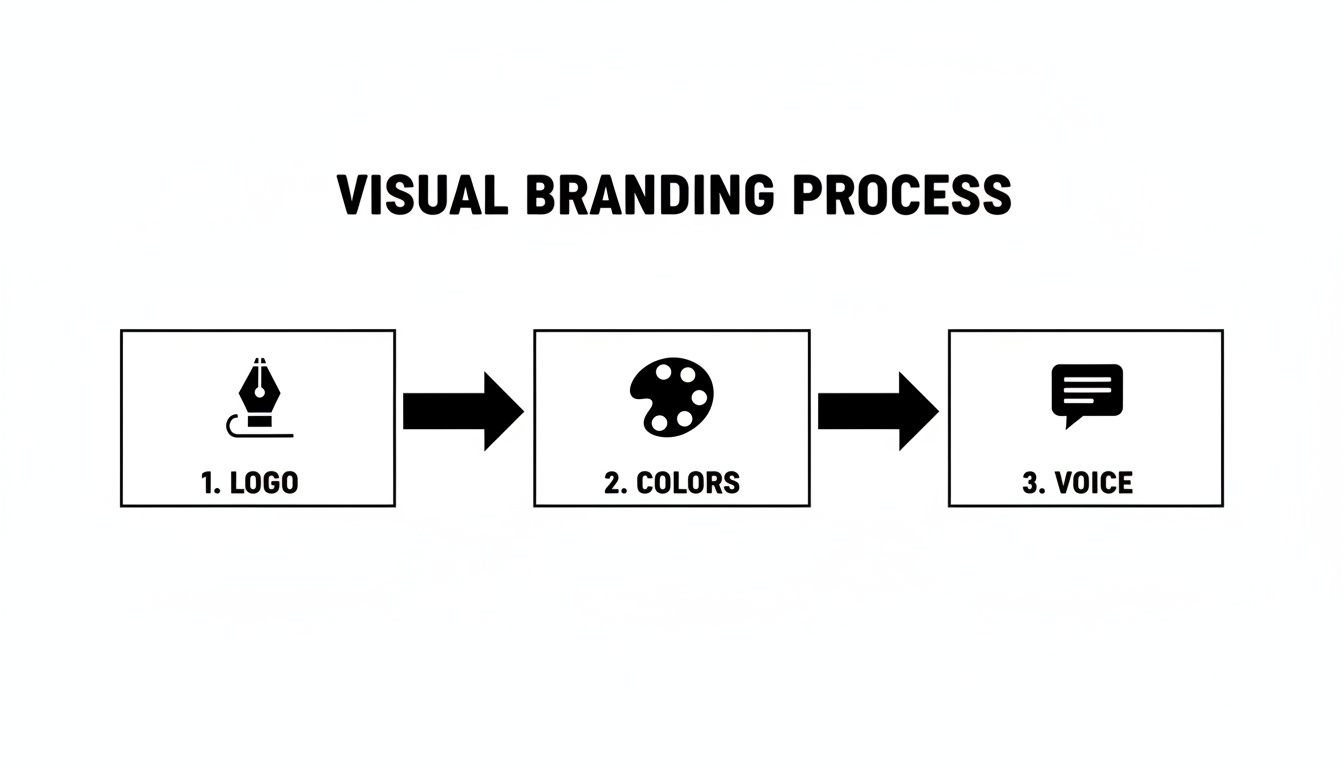
This flowchart shows the core steps of developing the new identity. These elements—logo, colors, and voice—have to be locked in before you can even think about the launch plan.
A detailed checklist is your best friend for keeping all the moving parts straight. Here’s a simple framework to get you started.
Your Rebrand Rollout Checklist
Phase | Action Item | Key Consideration |
|---|---|---|
Pre-Launch | Internal Team Briefing | Ensure everyone understands the "why" behind the change. |
Pre-Launch | Finalize All New Assets | Have every digital and print file ready to go. |
Launch Day | Update Website & Digital Profiles | Flip the switch on your website, social media, and email signatures. |
Launch Day | Send Public Announcement | Email your customers, post on social media, issue a press release. |
Week 1 | Roll Out New Physical Collateral | Distribute new business cards, brochures, and internal documents. |
Week 1 | Update On-Site Signage | Replace old storefront, lobby, and directional signs. |
Month 1 | Launch New Vehicle Wraps/Apparel | Get your mobile billboards and team uniforms out in the wild. |
Post-Launch | Monitor Feedback & Mentions | Keep an eye on social media and customer emails for reactions. |
This checklist helps ensure nothing falls through the cracks, turning a potentially chaotic process into a well-orchestrated event.
Managing Your Rebrand Budget
Let’s talk money. Rebranding is an investment, and the launch phase comes with its own price tag. It’s crucial to budget for all the new assets you’ll need to create.
Here are some key costs to plan for:
Signage: New storefront signs, lobby graphics, and wayfinding signs.
Vehicle Wraps: A powerful moving billboard for local businesses in Chicagoland.
Print Materials: Business cards, brochures, flyers, and company letterhead.
Digital Assets: Potentially a new website, updated social media graphics, and email templates.
Team Apparel: Branded shirts or uniforms for your crew.
Smart budgeting means prioritizing. What gives you the most bang for your buck? For a contractor, new vehicle wraps are a no-brainer. For a salon, the storefront sign and website are key. We can help you figure out where your dollars will work hardest. Learn more about how to improve brand awareness and get your local business noticed in our other guides.
A well-planned launch turns your rebrand from an internal project into a public statement of growth and confidence. If you need help orchestrating a seamless rollout, call the experts at Creative Graphics Solutions at 219-764-1717.
Living Your New Brand and Measuring Success
The launch party is over, the new signs are up, and the freshly wrapped vans are hitting the streets of Portage. It’s tempting to kick your feet up and call it a day. But here’s the thing: this is where the real work begins. Now you have to actually live the brand.
A new brand isn’t just a fancy new outfit; it’s a promise. Consistently keeping that promise is how you build trust and turn all that hard work into actual, measurable results. It means weaving your new identity into the very DNA of your company culture.
Turning Your Team into Brand Champions
Your brand is only as strong as the people repping it every single day. From the person answering the phones to the tech out on a job site, your team is your brand in action. They have to get it, believe in it, and feel like they have the power to deliver on its promise.
This is way more than just sending out a memo. It’s about:
Constant Coaching: Don’t just tell them once. Regularly go over the brand’s core message, values, and voice. Show them what “on-brand” customer service looks like in scenarios they actually face.
Real Empowerment: Give them the tools and the freedom to make decisions that line up with the brand. An employee who feels trusted and capable delivers a ridiculously better customer experience.
Shouting Out the Wins: Celebrate team members who go above and beyond to embody the new brand. A little positive reinforcement goes a long way in making the new vibe stick.
A brand is the sum of every single interaction a customer has with your business. Your team is on the front lines of those interactions, making them the most important part of your brand’s long-term success.
Tracking What Actually Matters
So, how do you know if any of this is actually working? You measure it. A boost in team morale is great, but you need to be tracking specific Key Performance Indicators (KPIs) to see the real-world impact. Forget the vanity metrics; let’s focus on the data that directly connects to your bank account.
Key Metrics to Monitor Post-Rebrand
The KPIs you track will depend on your specific goals, but these are the heavy hitters we tell our Chicagoland clients to watch like a hawk.
Website Traffic & User Behavior: Are more people finding your site? More importantly, are they sticking around longer and clicking on more pages? Tools like Google Analytics will tell you if your new message is hitting home online.
Lead Quality: It’s not about getting more leads; it’s about getting the right leads. Are you attracting more of your ideal customers—the ones who see your value and are ready to pull the trigger?
Social Media Engagement: Look past the likes. Are people commenting, sharing your stuff, and asking questions? Real engagement means your new brand voice is building an actual community, not just collecting followers.
Sales & Revenue: This is the ultimate test, right? Keep a close eye on your sales pipeline, the average size of a deal, and the lifetime value of a customer. A solid rebrand should make all these numbers climb over time.
Customer Feedback: Pay attention to your online reviews and any customer surveys you send out. Are people mentioning the new look or talking about a better experience? That kind of feedback is pure gold.
Living your brand isn't a one-and-done task; it's an ongoing commitment. By getting your team fired up and consistently measuring what matters, you’ll make sure your rebrand delivers a killer return for years.
If you need a hand turning your new brand into a living, breathing part of your business, give Creative Graphics Solutions a call at 219-764-1717.
Your Rebranding Questions, Answered
Look, we get it. Deciding to rebrand your business feels like a massive step, and you’ve probably got a million questions swirling around. That’s not just normal; it’s smart.
Here are the straight-up, no-fluff answers to the questions we hear most from small business owners right here in the Chicagoland area.
The Big One: How Much Does This Actually Cost?
This is always the first question, and the honest answer is: it depends. There’s no one-size-fits-all price tag.
A simple logo refresh with some new business cards is a totally different ballgame than a full-blown strategic rebrand—we're talking a new website, messaging that actually connects, fresh signage, and wrapping your entire fleet of trucks.
At Creative Graphics Solutions, we build custom packages for Northwest Indiana businesses designed to hit your specific goals without blowing up your budget. Give us a call at 219-764-1717 for a free quote that’s actually tailored to your business, not some generic template.
Will I Scare Away My Regulars If I Rebrand?
This is a real and totally valid fear. But here’s the thing: a rebrand done right actually makes your relationship with current customers even stronger.
The secret? Communication. You can't just drop a new logo on them and expect a parade. When you’re open and clearly explain the why behind the change—how you’re evolving to serve them better—you bring them along for the ride.
A rebrand that’s built on real customer feedback is one they won’t just understand; they’ll get excited about it. We help our clients create smart launch plans that build hype with their loyal fans while pulling in a whole new wave of ideal customers.
Okay, So How Long Is This Going To Take?
Patience is your best friend here. The timeline is tied directly to how deep we need to go.
A straightforward visual refresh (think updated logo and a new color palette) might take 1–3 months.
A full rebrand—with a deep dive into strategy, new messaging, and a launch across all your channels—is more like a 6 to 12-month journey.
Rushing the first phase—the audit and strategy—is one of the most common and damaging mistakes we see. We'll work with you to set a realistic timeline that doesn't derail your daily operations and makes sure every single piece is executed perfectly.
A new logo on a broken strategy is like a fresh coat of paint on a crumbling foundation. The real work happens before a single design is even sketched out.
Do I Need a Full Overhaul or Just a New Logo?
This question gets right to the heart of what’s not working in your business. And the answer depends entirely on the problem you're trying to fix.
If your logo just feels a bit dated but your mission, values, and who you serve are still rock solid, a brand refresh is probably all you need. It’s a targeted facelift for your visuals.
But a full rebrand is the move if your business has fundamentally changed. Are you chasing a new type of customer? Have your core services shifted? Is your message just not landing anymore? If you answered yes to any of these, it's time for a deeper change. We can help you figure out the right path for your business.
Ready to upgrade your brand and get more customers in Northwest Indiana? Creative Graphics Solutions is here to guide you through every step of the rebranding process. Request a free quote today or call us at 219-764-1717.
Comments