
How to Develop a Brand Strategy That Wins More Customers
Before we dive in, let's get one thing straight. A brand strategy isn't just picking a cool color palette or getting a slick new logo. Sure, those things are part of the equation, but they’re the finishing touches, not the foundation.
This guide is a practical, no-fluff playbook on how to develop a brand strategy that defines your promise and turns it into real, measurable growth for your business.
Your Brand Is More Than a Logo—It’s a Promise
Think of your brand as the gut feeling people have about your business. It's the reason a homeowner in Portage, Indiana, trusts your contracting company over another. It's why a customer walks into your local shop instead of driving to a big-box store in Chicagoland.
At its core, your brand is the promise you make—and keep—with every single customer interaction. It’s what you stand for and how you make people feel. We'll walk through everything from understanding your audience to crafting a message that actually connects.
For any local business owner, contractor, or entrepreneur in Northwest Indiana, a solid brand strategy is your most valuable asset for long-term success. It answers the big question: why should a customer choose you? You can get a deeper look into this by exploring the power of great brand storytelling.
This simple visual breaks down how a brand really works. It starts with a visual mark, evolves into a binding promise, and ultimately fuels your growth.
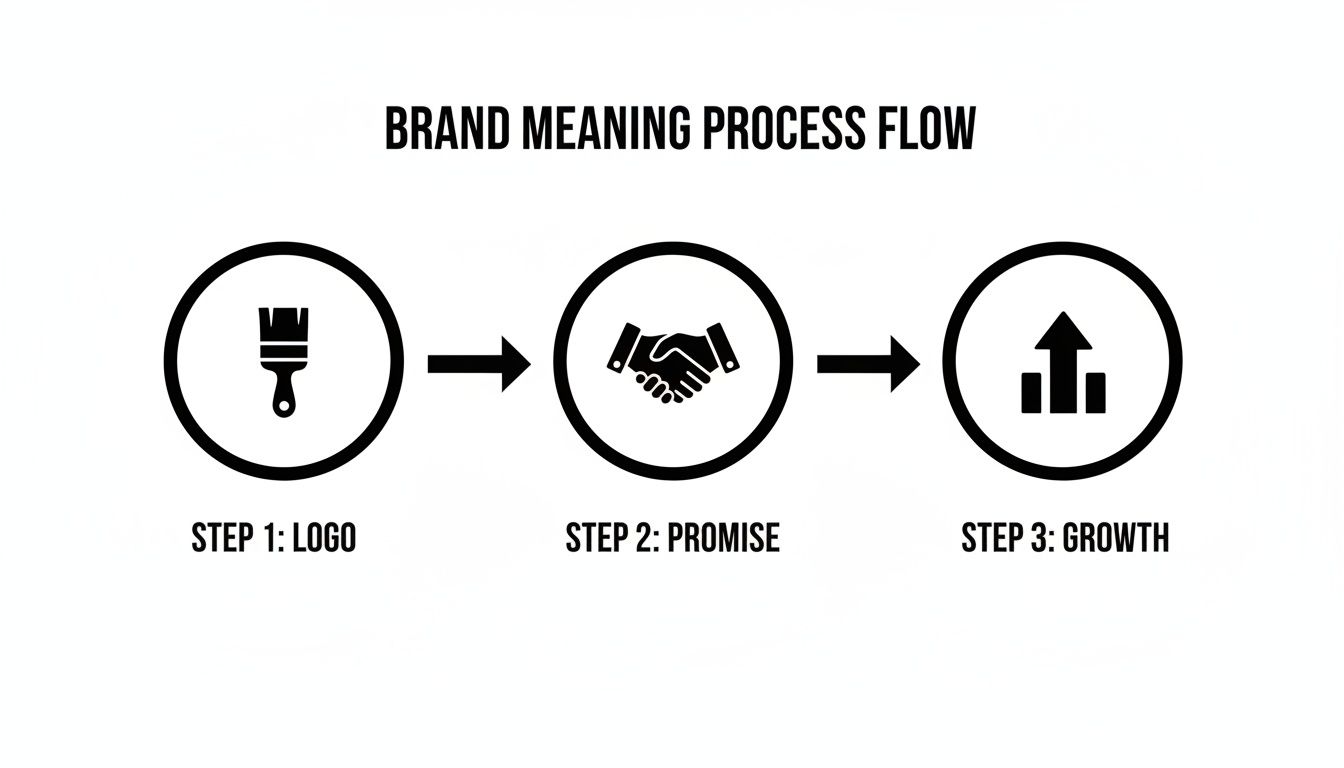
This process shows that your logo is just the beginning. The real power is in consistently delivering on your promise, which is what leads to a stronger, more profitable business. If you need help turning your vision into a reality, give Creative Graphics Solutions a call at 219-764-1717.
Start with Deep Discovery to Define Your Brand Foundation
You can't build a brand that lasts on guesswork. The very first move—the one that sets the stage for everything else—is deep discovery. This isn't fluffy corporate talk; it's a mix of honest self-reflection and clear-eyed research to find the real soul of your business.
This process forces you to answer the tough questions. It's the bedrock of a brand that connects with actual people and stands out, whether you're a local business in Portage, Indiana, or the greater Chicagoland area. Get this part right, and the rest falls into place.
Asking the Right Foundational Questions
Before you even think about spying on the competition, you have to look inward. Your brand’s purpose is your “why”—the real reason you get out of bed in the morning, beyond just making a profit. Your values are the lines you won't cross, the principles that guide every decision.
Grab your team and hash out the answers to these core questions:
Our Mission: What are we actually trying to do for our customers? What problem do we solve?
Our Vision: If we knocked it out of the park, what would the future look like? What impact will we have made?
Our Core Values: What are the 3-5 non-negotiable principles that define how we act, treat people, and run our business?
These answers aren't just for a poster in the breakroom. They become the filter for your marketing, your customer service, and even the people you hire. It's where your brand's authenticity comes from.
Conduct a Simple SWOT Analysis
A SWOT analysis is a ridiculously simple but powerful way to audit your business. It gives you an honest, no-fluff look at where you stand by identifying your Strengths, Weaknesses, Opportunities, and Threats.
Let’s make this real. Imagine you run a food truck in Northwest Indiana.
SWOT Category | Description | Food Truck Example |
|---|---|---|
Strengths | What you do better than anyone else (internal). | Killer family-recipe tacos; prime spot at a busy farmers market; a loyal following on Instagram. |
Weaknesses | The not-so-great stuff you need to fix (internal). | Tiny menu; only one person working the truck (hello, long lines); still a cash-only operation. |
Opportunities | External factors you can jump on. | A huge new summer festival was just announced; the office park down the street has zero good lunch options. |
Threats | External factors that could mess things up. | The cost of avocados is skyrocketing; a new taco truck just opened two blocks away; new city vendor regulations are coming. |
This quick exercise gives you a clear snapshot. You’ll lean into your strengths and opportunities to shape your brand message.
Uncover Your Unique Selling Proposition
Your Unique Selling Proposition (USP) is the one thing that makes you different. It’s your answer to the question, “Why should I pick you over all the other options?”
And no, "great service" or "quality products" doesn't cut it—that's what everyone says. Your USP has to be specific, compelling, and something your customers actually care about. Find it at the intersection of what your audience wants and what you do better than anyone else.
A powerful brand is built on consistency. When your message, visuals, and customer experience all tell the same story, you create a seamless and trustworthy identity that people remember. This is how you turn first-time buyers into loyal fans.
For an HVAC contractor in a crowded market, consistency is everything. When your branding is uniform across the board, you can boost revenue by up to 23%. That means your logo, colors, and tagline need to look and feel the same on your truck wraps, your website, and your business cards. Aligning your brand promise with your real-world service can lead to 3.5 times more revenue growth. Want to dig into the numbers? Check out these key branding statistics from Blacksmith.agency.
This discovery phase lays the groundwork for a brand that feels real because it is real. It’s built on who you are, what you stand for, and the unique value you bring to the table.
Need a hand uncovering the soul of your brand? Call the experts at Creative Graphics Solutions at 219-764-1717.
Nail Down Your Ideal Customers with Actionable Personas
Let's get one thing straight: your brand isn't for everyone. And that’s a good thing.
Trying to be the go-to for the masses is the fastest way to become white noise. A killer brand strategy doesn't shout into a crowded room; it pulls the right person aside for a quiet, meaningful conversation. This is where creating customer personas flips your marketing from a guessing game into a laser-focused strategy.
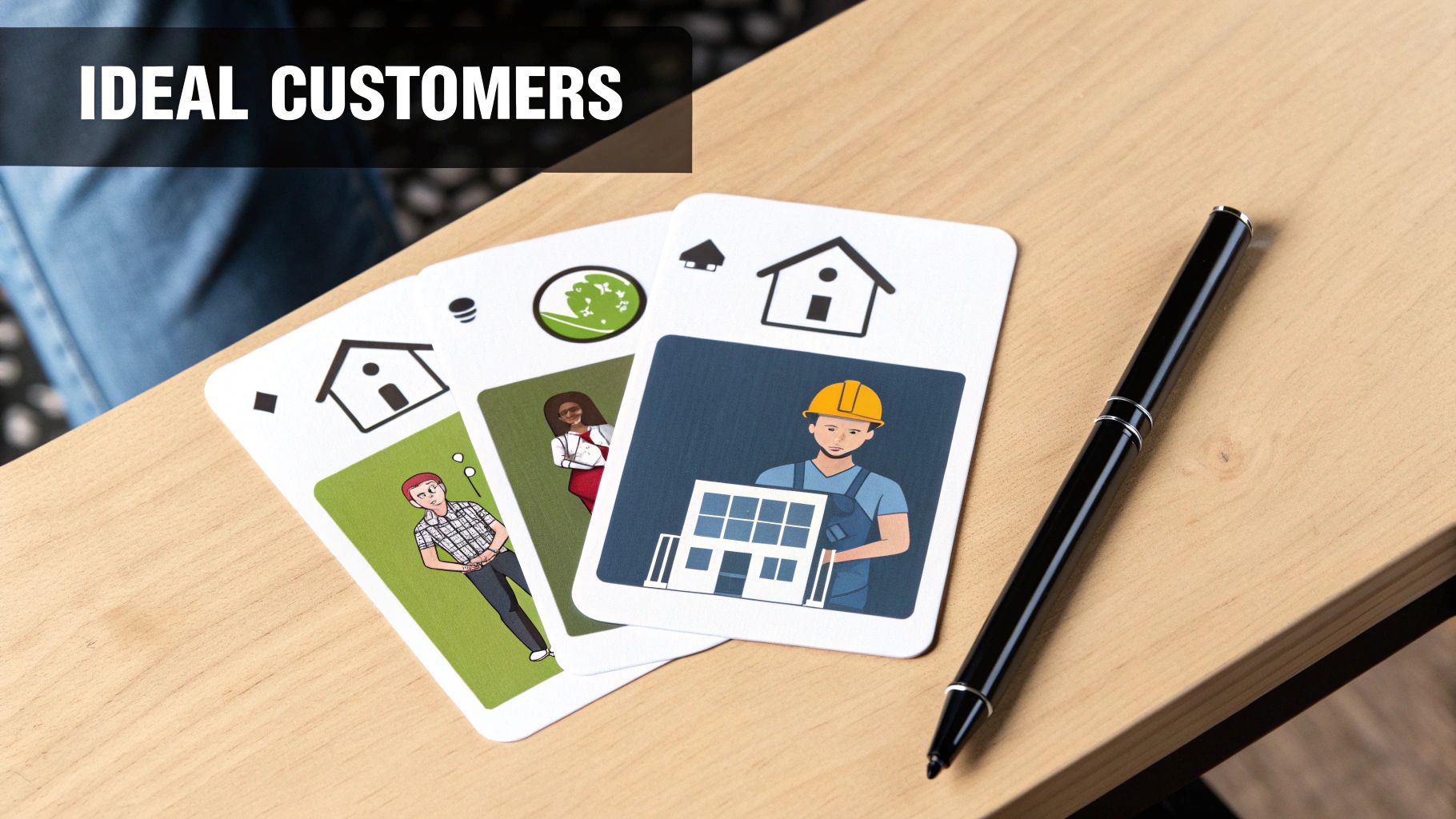
Think of personas as semi-fictional highlight reels of your ideal customers. They’re built from real-world data and give a name, face, and story to the audience you're trying to win over. Once you have them, crafting messaging that actually hits home becomes infinitely easier.
Go Deeper Than Basic Demographics
Building a persona is more than just jotting down an age range and a zip code. It's about getting into the heads of your audience—what are their goals, what keeps them up at night, what motivates them to finally pick up the phone? You need to understand why they buy, not just what they buy.
Let's make it local. A contractor in Valparaiso isn't just targeting "homeowners." They're targeting "Project-Ready Paul," a 45-year-old homeowner who values reliability and clear communication over a bargain-basement price. A salon in Crown Point isn't just for "women." It's for "Self-Care Susan," a 30-something professional who views her appointments as a non-negotiable part of her wellness routine.
By defining exactly who you are talking to, you automatically clarify who you are not. This isn't about exclusion; it's a strategic move that sharpens your message and makes every dollar in your marketing budget work harder.
When you have this level of detail, every piece of content, every ad, and every vehicle wrap designed by a team like Creative Graphics Solutions speaks a language your ideal customer instantly gets.
How to Dig Up Real-World Insights
So, where does all this juicy info come from? It’s closer than you think. You don't need a massive research budget to build personas that work. You just need to be a little nosy and ask the right questions.
Start digging in these goldmines:
Your Current Customer List: Who are your absolute best customers right now? The ones you wish you could clone? Look for patterns in their jobs, the services they use, and the feedback they give you. A friendly chat during a service call can tell you more than a formal focus group.
Social Media Analytics: Platforms like Facebook and Instagram are packed with audience insights. Dive into the demographics and interests of the people who follow and engage with your page. You might find some surprising trends.
Super-Simple Surveys: Use a free tool like Google Forms to create a quick survey. Ask just 3-5 questions about their biggest challenges, what they look for in a service provider, and where they hang out online.
Once you’ve got some data, aim to build out 2-3 detailed personas. Quality beats quantity here. A few rock-solid personas are way more useful than a dozen vague ones.
Your Go-To Persona Template
Get your findings organized into a simple, scannable document. This template becomes the North Star for your entire team, making sure everyone is on the same page about who you're serving.
Here’s a practical template to steal:
Persona Element | What to Include | Example: "Project-Ready Paul" |
|---|---|---|
Background | Job, family, lifestyle details. | 45, works in sales, married with two high schoolers. Lives in a suburb of Portage. |
Goals | What do they want to achieve? | Wants to boost his home's value with a new deck before his daughter's graduation party. |
Pain Points | What drives them crazy? | Hates flaky contractors who ghost him or leave a mess. Stressed about projects going over budget. |
Communication | How do they like to connect? | Prefers quick text updates over phone calls. Always reads online reviews before hiring anyone. |
With these personas locked in, you'll have a crystal-clear picture of who you're talking to. Every decision—from your brand voice to your visual identity—suddenly becomes more focused and effective.
Need a hand figuring out who your "Paul" or "Susan" is? Give us a call at 219-764-1717 for a strategy session.
Craft Your Brand Positioning and Core Messaging
Okay, you’ve done the soul-searching and you know exactly who you’re talking to. Now for the fun part: translating all that internal discovery into words that actually connect with people. This is where you pivot from thinking about your brand to talking about it—in a way that makes you the obvious choice.
We're going to start with your Brand Positioning Statement. Think of this as your internal North Star. It's a short, sharp sentence that locks down your unique spot in the market. It’s not a tagline you’ll plaster on a billboard, but a secret weapon that keeps every single marketing decision you make on-point and consistent.
Define Your Unique Place in the Market
Your positioning statement is the glue that holds your entire strategy together. It forces you to get brutally honest about what makes you different and why anyone should care. It’s the strategic heart of your brand.
Here’s the simple-but-powerful formula:
For [Your Target Audience], [Your Brand Name] is the only [Your Category] that delivers [Your Unique Promise/Benefit] because only you [Your Evidence/Proof].
Let’s make this real. Imagine a local catering company right here in Portage, specializing in corporate events. Their statement might sound something like this: "For busy office managers in the Chicagloland area, Tasteful Traditions Catering is the only corporate caterer that delivers a stress-free, impressive culinary experience because only we offer a dedicated event coordinator and a 100% on-time guarantee."
Boom. In one sentence, they’ve nailed their audience (office managers), their category (corporate catering), their promise (stress-free and impressive), and their proof (a dedicated coordinator and a rock-solid guarantee).
Develop Your Key Messaging Pillars
With your positioning locked in, you can start building out your core messaging—the handful of key themes and stories you’ll tell over and over again, everywhere. These pillars ensure you sound like the same company, whether it's on a social media post, a vehicle wrap designed by Creative Graphics Solutions, or a simple sales email.
Your main messaging pillars need to cover:
Value Proposition: This is your "what's in it for me?" statement, boiled down to its most powerful form. It’s the tangible benefit a customer gets by choosing you. For a local contractor, it could be as simple and powerful as, "We finish your project on time and on budget, guaranteed."
Brand Story: Facts tell, but stories sell. What’s the real story behind your business? The challenges you overcame? The "aha!" moment that started it all? Your story makes your brand human, relatable, and much more memorable than a list of services.
Tagline: This is the catchy, public-facing slogan that sticks in people's minds. It’s the headline for your brand promise, distilled into just a few memorable words.
Find Your Authentic Brand Voice and Tone
How you say something is just as important as what you say. Your brand voice is your company’s personality, and it has to show up consistently, everywhere. Are you the buttoned-up, authoritative expert like a financial advisor? Or are you the friendly, creative confidant like a neighborhood salon stylist?
This isn’t just fluffy marketing talk. A whopping 73% of consumers say they love a brand because of its helpful customer service—and that service is delivered through your brand’s voice and tone. Getting this right builds instant trust.
A brand voice isn't about adopting a fake persona. It's about amplifying the genuine personality that already exists within your business and translating it into a consistent communication style that your ideal customers will recognize and trust.
To nail this down, think of your voice on a spectrum. A non-profit in Valparaiso focused on community impact will have a completely different vibe than a high-end boutique in Chesterton known for curated luxury.
Here's a quick way to map out your brand's personality. Just place an 'X' on the spectrum for each characteristic to define where your voice should land. This little chart is a lifesaver for keeping your team's communication consistent.
Define Your Brand Voice and Tone
Characteristic | Voice 1 | Spectrum | Voice 2 |
|---|---|---|---|
Personality | Funny | ] - ] - X] - ] - ] | Serious |
Formality | Casual | ] - X] - ] - ] - ] | Formal |
Tone | Enthusiastic | X] - ] - ] - ] - ] | Matter-of-fact |
Language | Simple | X] - ] - ] - ] - ] | Technical |
This simple exercise gives you a quick reference to make sure your emails, social posts, and website copy all sound like they’re coming from the same place. It's a small step that makes a huge difference in how professional and put-together your brand feels.
With your positioning defined, your messaging pillars built, and your voice established, you officially have a complete verbal identity. This is the toolkit you'll use to communicate your value clearly and consistently, building a brand that people not only recognize but actually feel connected to.
If you’re struggling to put your brand’s essence into words, we can help. Call Creative Graphics Solutions at 219-764-1717 to chat about your brand messaging.
Design a Visual Identity That Turns Heads
Alright, this is where the magic happens. We've done the deep thinking, and now it's time to take all that strategy and give it a face. This is where your brand stops being an idea and becomes something people can actually see and touch. Your visual identity is the whole package—the logo on your business cards, the graphics wrapped around your company truck, the font on your website. It’s your brand’s first impression.
The goal here is to create a visual language that connects instantly with your ideal customers. We're not trying to make you a graphic designer overnight. Instead, we’re arming you with the right knowledge to make smart decisions and work like a pro with a studio like Creative Graphics Solutions. The point isn’t just to make something pretty; it's to create something powerful.
Want a deeper dive? We've got a whole guide on how to create a brand identity that walks you through the nitty-gritty.
It's So Much More Than a Logo
Let's be real: a cheap logo from some online generator might feel like a quick win, but it usually causes more problems down the road. It has zero strategy, no originality, and none of the professional polish you need to build real trust. Your visual identity is a complete system, and the logo is just one piece of the puzzle.
Here are the core components you need to nail:
Logo Design: This is your brand's signature. A killer logo is simple, memorable, and looks great everywhere—from a tiny social media icon to a massive sign on your Portage, Indiana storefront.
Color Palette: Colors create feelings. A well-chosen palette reinforces your brand’s personality and makes you instantly recognizable. Think about the energetic red of a popular fast-food chain versus the calming blue of a healthcare brand. It’s no accident.
Typography: The fonts you pick say a ton about your brand. A bold, no-nonsense font might be perfect for a Chicagoland contractor, while an elegant, clean font is a better fit for a high-end salon.
Imagery: This covers your style of photography, illustrations, and icons. It sets the mood and tells a visual story that words alone just can’t capture.
Design for Your Customer, Not for You
Great design isn’t about your personal favorite color. It’s about what clicks with your target audience. Every single visual choice you make should be filtered through the lens of your customer personas.
Would "Project-Ready Paul" hire a contractor with a playful, cartoonish logo? Probably not. Would "Self-Care Susan" feel pampered by a salon with a harsh, industrial color scheme? Definitely not. Your visuals have to match the promise you're making. If your brand is all about expertise and reliability, your design better look clean, professional, and organized.
Your visual identity is the ultimate shortcut to building recognition. When used consistently, it creates a mental file in your customer's brain, making you the first one they think of when they need your service.
This consistency is what separates the amateurs from the pros. It’s about making sure your business looks, feels, and sounds the same everywhere, building trust and a sense of "I know these guys."
For local businesses, especially in a competitive market like Northwest Indiana, a sharp visual identity is a massive advantage. Today, a staggering 71% of Gen Z and Millennials find new brands on social media. That makes platforms like Instagram and TikTok your visual storefront. A cohesive, professional look can be the one thing that stops the scroll, helping you stand out and actually grow your business.
At the end of the day, remember this: great design isn't just decoration. It’s a strategic asset that screams your value, builds trust, and pulls in the right kind of customers.
Ready to build a visual identity that works as hard as you do? Give the team at Creative Graphics Solutions a call at 219-764-1717.
Activate Your Brand and Actually Start Growing
You've done the hard work. All the deep thinking, the messaging workshops, and the design concepts have led to this moment. But let’s be real: a brand strategy isn’t a trophy to hang on the wall. It’s a playbook, and it only works if you put it in the game.
This is the activation phase—where you finally introduce your brand to the world and start building real momentum. A strategy sitting in a Google Drive folder is just a collection of cool ideas. To turn it into a growth machine, you have to get it out there, consistently, everywhere your customers might find you.
First, Create Your Brand Style Guide
Consistency is everything. But you can't expect your team (or your freelancers) to guess what "on-brand" means. You need a rulebook. That’s where a brand style guide comes in, and it doesn't need to be some hundred-page corporate behemoth. For a small business, a simple PDF is perfect.
This guide is your single source of truth for your brand's look and feel, making sure everyone—from a new hire to a marketing partner—is on the same page.
At a bare minimum, your style guide should cover:
Logo Usage: Clear do's and don'ts. Show the right way to use your logo, specify minimum sizes, and list common mistakes to avoid (like stretching it, changing colors, or slapping it on a busy background).
Color Palette: Your primary and secondary colors, complete with their exact color codes (HEX, RGB, CMYK). No more "close enough" shades of blue.
Typography: The specific fonts for headlines, body copy, and call-outs. Include details on sizes, weights, and spacing to keep your text looking sharp and intentional.
Roll Out Your Brand With a Plan
Launching a new or refreshed brand shouldn't feel like a chaotic fire drill. Think about all the places customers interact with your brand—we call these touchpoints. The key to a smooth, professional transition is a simple rollout checklist.
Your launch checklist should cover every asset, big or small:
Digital Assets: Your website, social media profiles (cover photos, avatars), email signatures, and online ad templates.
Physical Assets: Vehicle wraps, storefront signage, business cards, uniforms, and any printed marketing materials.
Internal Comms: Invoices, customer service scripts, and email templates that your team uses daily.
Measure What Actually Matters
Okay, your brand is officially out in the wild. How do you know if it's actually working? Forget vanity metrics like social media likes. For a small business, you need to track the numbers that directly impact your bottom line.
Keep your eye on a few key performance indicators (KPIs) that tell the real story:
Brand Awareness: Are more people in Portage searching for your business by name? Tools like Google Analytics can show you this. It's the difference between someone searching for "plumber" versus "Johnson Plumbing."
Customer Loyalty: Are you seeing more repeat customers? Are your online reviews getting better? That's a sign your brand is building trust.
Lead Quality: Are the right kinds of customers finding you? Are your sales conversations getting easier because people already "get" what you do?
A brand is a living, breathing thing. It needs attention, care, and the occasional tweak to stay relevant and keep driving growth.
Ready to activate your brand and see what it can really do? The team at Creative Graphics Solutions can make sure your rollout is seamless. Give us a call at 219-764-1717 to get started.
Got Questions About Brand Strategy? We’ve Got Answers.
Even with the best game plan, jumping into your brand strategy can feel like a big leap. It’s a serious investment for any small business owner, so let’s clear the air and tackle the questions we hear all the time from entrepreneurs and contractors right here in Northwest Indiana.
Getting these straight will help you move forward with the confidence that you’re putting your money where it counts—into your business’s future.
So, What’s This Going to Cost Me?
This is usually the first thing people ask, and the real-talk answer is: it depends. The price tag is tied directly to what you need done.
A simple logo refresh and a new color palette for a one-person-show is a totally different ballgame than a complete brand overhaul for a growing company that needs vehicle wraps, new signage, and a full website to match.
Think of it like building a house. You could grab a toolkit from Home Depot and DIY it, or you could bring in an architect and a full construction crew.
The DIY Route: This is the easiest on the wallet upfront, no question. You can use this guide to get the foundation laid yourself, which is a fantastic start. The risk? You might miss the professional polish and strategic thinking an expert brings to the table.
Bringing in the Pros: Working with a studio like Creative Graphics Solutions is an investment in experience. You’re paying for a proven process, an outside perspective that sees what you might miss, and high-quality work that saves you from costly do-overs later. We can handle it all, from the initial strategy to the final design, making sure everything works together seamlessly.
How Long Until I See a Payoff?
Branding isn’t a magic wand you wave for overnight success; it’s a long-term play to build trust and get recognized. While a fresh rebrand can create some immediate buzz, the real magic happens over time. You won’t triple your sales in the first week, but you will start seeing little wins that tell you it’s working.
Keep an eye out for these signs in the first few months:
You start getting calls from higher-quality leads—the kind of customers who already "get" what you do.
People are actually engaging with your posts on social media.
More people are typing your business name directly into Google.
You get compliments from customers on your sharp, professional new look.
A solid brand strategy is like a flywheel. It takes a good push to get going, but with consistent effort, it builds momentum that drives real, sustainable growth for years. It just keeps spinning.
Can I Just Do This Myself?
Absolutely—up to a certain point. As the business owner, nobody knows your mission and your "why" better than you do. You can definitely—and you should—handle the first steps like the initial discovery, nailing down your core message, and figuring out who your ideal customers are. That’s exactly what this guide is designed to help you do.
But there comes a time when calling in an expert is the smartest move.
Professional designers and brand strategists have the experience to see your business through your customer’s eyes. We know how to take your vision and turn it into a visual identity that connects and an activation plan that actually gets you somewhere. For a custom quote for your business in Portage or the greater Chicagoland area, just give us a call at 219-764-1717.
Ready to stop guessing and start building a brand that brings in customers? The team at Creative Graphics Solutions is here to help you nail down a strategy and design a look that works as hard as you do. Request a free quote today!
SEO Title: How to Develop a Brand Strategy: A Guide for Local Business Meta Description: Learn how to develop a brand strategy that wins more customers. This guide covers everything from brand discovery to visual identity for your local business.
Comments