
What Is a Logo Lockup and Why Your Brand Needs One
So, you have a logo. But what in the world is a logo lockup? Let’s ditch the confusing design jargon for a moment.
A logo lockup is the final, official arrangement of your brand’s essential visual elements—your symbol, your business name, and maybe a tagline—all locked together into a single, cohesive unit. Think of it as your brand's team photo where everyone has an assigned spot. You wouldn't move people around randomly, and you don't do that with your lockup, either. This is the cornerstone of a professional brand identity.
Breaking Down The Logo Lockup
If your logo is the star player, the lockup is the entire starting lineup presented in its official formation. It’s the go-to, non-negotiable version of your brand identity that ensures you show up looking consistent and professional everywhere—from a truck wrap driving through Portage, Indiana, to your Instagram profile.
This isn't just about looking sharp; it’s about building real trust. When customers see that same organized logo lockup on your website, your storefront, and your business cards, it sends a powerful signal: you're reliable and you care about the details.
A logo lockup is a fixed, unified arrangement of a brand's key visual elements—like the logomark (that iconic symbol or icon), logotype (the stylized brand name), and sometimes a tagline—locked together in precise positioning, sizing, and spacing to ensure unbreakable consistency.
This consistency is a seriously powerful business tool. In fact, consistent branding through elements like logo lockups can boost brand recognition by a whopping 80%. Even better, its steady use can drive revenue up by an average of 33%. You can find more killer insights on building a strong brand identity over at anastasiasalazar.com.
For any local business in Northwest Indiana—whether you’re a contractor, a salon owner, or running a food truck in the Chicagoland area—this consistency is your secret weapon. It transforms your brand from just another name into a memorable, professional force.
The Core Components of a Logo Lockup
At its heart, a logo lockup is made of a few key ingredients working together. Understanding these parts is the first step toward building a brand that gets noticed and remembered.
Here’s a simple breakdown of what goes into a typical lockup:
Component | What It Is | Example |
|---|---|---|
Logomark | The symbol or icon people recognize without words. | The Nike swoosh or the Target bullseye. |
Logotype | Your business name styled in a specific font. | Coca-Cola’s iconic script or Google's colorful lettering. |
Tagline | A short, memorable phrase that captures your brand's vibe. | Nike's "Just Do It." |
By combining these elements with strict rules for spacing and arrangement, a professional designer creates the polished, final lockup you’ll use to represent your business everywhere.
Got questions? Give the Creative Graphics Solutions team a call at 219-764-1717.
The Anatomy of Your Logo Lockup
Think of your logo lockup like your family’s secret recipe. Every ingredient has its job, but the real magic happens when you combine them in a specific, never-changing order. To really get what a logo lockup is, you have to know what goes into it.
So, let's pull apart the key pieces. Once you see how these individual parts function, you’ll understand how they team up to tell your brand’s story in a single glance.
The Logomark: The Icon
First up, you have the logomark. This is the purely visual part of your brand—the symbol or icon people recognize instantly, even with zero text. It’s your brand’s silent handshake.
Think of Apple’s bitten apple or the Target bullseye. They’re so powerful they don’t need the company name to do the heavy lifting. For a local business in Northwest Indiana, a logomark could be a stylized snowflake and flame for an HVAC contractor, giving an immediate visual clue about what they do.
The Logotype: The Signature
Next is the logotype, which is just your business name styled in a specific, unique font. This isn't just typing your name in Arial and calling it a day; it’s a deliberate design choice that oozes your brand's personality.
Look at Coca-Cola’s famous script or the beefy, straightforward font FedEx uses. The logotype turns your name into a memorable piece of art. A Chicagoland contractor might go for a thick, sturdy logotype to communicate strength, while a Portage salon might pick an elegant, flowing script to suggest a touch of class. Want to see more examples? Our guide to professional logo design has you covered.
The Tagline: The Catchphrase
Finally, many lockups include a tagline. This is that short, catchy phrase that gets stuck in your customer’s head and sums up exactly what you’re all about.
Nike’s “Just Do It.” is probably the most famous one on the planet. It's more than a slogan; it's a whole vibe. A great tagline anchors your brand’s purpose and gives people something memorable to latch onto.
Your tagline makes it crystal clear what you stand for, whether it’s "Quality You Can Trust" for a local builder or "Your Style, Perfected" for a personal brand.
When these three elements—the mark, the type, and the tagline—are arranged into a fixed, official composition, they become your logo lockup. This single, cohesive unit is the cornerstone of your brand, making sure you look professional and consistent every single time. Got a vision but need a hand getting it right? Give us a call at 219-764-1717.
Choosing the Right Type of Logo Lockup
Not all logo lockups are created equal, and the one that works for your brand depends entirely on where you plan to slap it. Think of it like choosing the right tool for a job—you wouldn't bring a sledgehammer to hang a picture frame. The same goes for your brand’s most important visual asset.
Picking the right configuration is what makes your brand look sharp and professional everywhere, from a massive billboard to that tiny profile picture on Instagram. Let's break down the most common types and see where they really shine.
This diagram shows you the basic building blocks of a logo lockup—the logomark, the logotype, and the tagline—and how they come together.
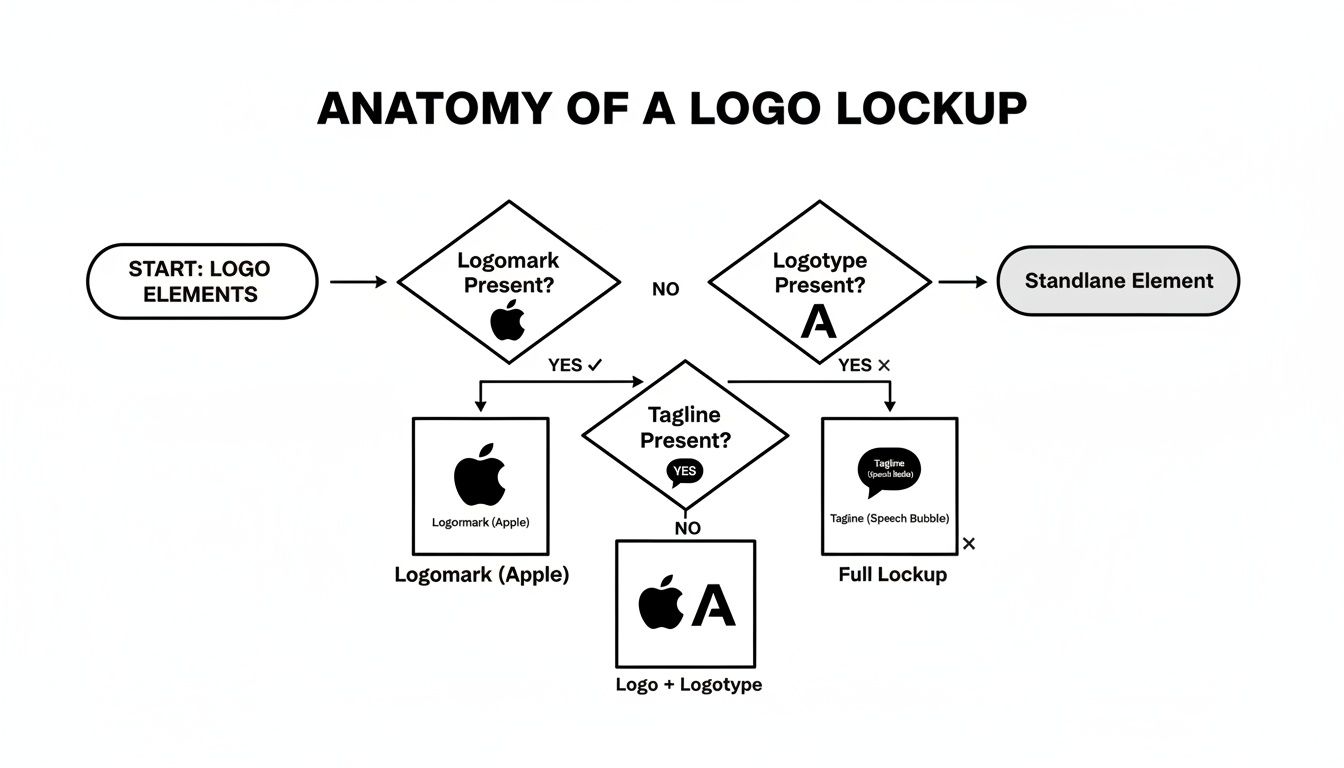
Think of these elements like LEGOs. You can click them together in different ways depending on what you need to build.
Horizontal Lockups for Wide Spaces
The horizontal lockup is the absolute workhorse of the branding world. It lines up your logomark and logotype side-by-side, creating a wide, rectangular shape that just feels right in a lot of places.
This format is crazy versatile and is usually the go-to choice for:
Website Headers: It fits perfectly across the top of a webpage without hogging a ton of vertical space.
Vehicle Wraps: For a local contractor, a horizontal lockup stretches beautifully along the side of a van or truck, maximizing visibility.
Business Cards & Letterhead: It gives off a clean, professional vibe that’s super easy to read.
It’s no surprise that horizontal lockups dominate, with a 65% usage rate in wide formats like website headers. A clean, simple horizontal lockup can even give a small business's social media engagement a 35% bump.
Vertical Lockups for Tight Spots
When you're squeezed for space, the vertical (or stacked) lockup is your new best friend. This version stacks your logomark on top of your logotype, creating a more compact, almost square-like shape.
It’s the perfect fix for applications like:
Social Media Profiles: It fits neatly into those little circles or squares on Instagram, Facebook, and LinkedIn.
Storefront Signage: It’s great for tall, narrow signs or those hanging blade signs you see downtown.
App Icons: If you’ve got an app, this is how you create a recognizable icon that pops on a phone screen.
A strong brand identity isn't rigid; it's flexible. Having both horizontal and vertical lockups ready to go means your brand is prepared to look its best, no matter where it shows up.
Choosing the right lockup is a huge step in building a brand that looks like it has its act together. For a deeper dive, check out our guide on how to create a brand identity that grows your business.
Badge and Emblem Lockups for a Premium Feel
Last but not least, we have the badge or emblem lockup. This style tucks the logomark and logotype inside a shape like a circle, shield, or crest. It often gives off a classic, established vibe that screams tradition and quality.
Badges are killer for:
Apparel and Uniforms: They look fantastic embroidered on hats, polos, or company jackets.
Product Packaging: A badge can act as a seal of quality on labels and boxes, giving your product a more premium feel.
Stickers and Decals: A local salon could use a slick emblem lockup on stickers to hand out to clients for a memorable, high-end touch.
Struggling to figure out which lockup is right for your business? We can help with that. Here’s a quick-and-dirty guide to get you started.
Which Logo Lockup Best Suits Your Business
Lockup Type | Best For | Industry Example |
|---|---|---|
Horizontal | Website headers, vehicle wraps, and wide-format advertising where you have more width than height. | A contractor’s truck wrap or an HVAC company’s website header. |
Vertical | Social media profiles, mobile app icons, and narrow signage where space is tight and square-ish. | A food truck’s profile picture or a salon’s retail product tags. |
Badge/Emblem | Apparel, packaging, and branding that needs a classic, premium, or handcrafted feel. | A nonprofit’s event sticker or a retail store’s branded tote bag. |
At the end of the day, having a few different lockups in your brand toolkit gives you the flexibility to show up consistently and professionally, no matter the context.
Need a hand sorting this out? Give our design experts a call at 219-764-1717.
How Logo Lockups Work for Local Businesses
Theory is great, but let's get practical. A well-designed lockup isn't just a pretty graphic you slap on a business card—it's a problem-solver. Let's see how the right lockup can make all the difference for a business right here in Northwest Indiana.
The Portage HVAC Contractor
Picture a heating and cooling company in Portage, Indiana. Their vans are their biggest marketing tool, zipping all over the region. They need a logo lockup that’s bold, legible from 50 feet away, and instantly says "we're the pros."
The perfect fit? A rugged, no-nonsense horizontal lockup.
The Logomark: A simple, strong icon—maybe a stylized flame and snowflake combo.
The Logotype: A thick, sturdy, all-caps font that just screams durability.
The Lockup: The icon sits cleanly to the left of the company name. This wide format is a perfect match for the side of a work van or the header of an invoice.
This isn’t just branding; it's a mobile billboard. It’s built for maximum visibility and instant recognition, helping them own their presence on every job site they pull up to.
The Valparaiso Salon Owner
Now, let's imagine a chic, modern salon in Valparaiso. The owner wants a brand that feels high-end, clean, and effortlessly stylish. Her brand has to look amazing on everything from tiny product bottles to her Instagram profile, so she needs versatility.
Her best bet is a flexible family of lockups. A sleek horizontal one is perfect for her website header and appointment cards. But for social media and product labels, a compact vertical lockup is the real star.
A vertical lockup stacks the brand elements, creating a polished, almost square shape. This format is perfect for fitting into the small, constrained spaces common in digital marketing and product branding.
By stacking a delicate, minimalist logomark above a graceful, scripted logotype, the lockup feels sophisticated and fits neatly into a small circle. Suddenly, it looks professional on a tiny Instagram profile pic and adds a touch of class to a retail bag.
The Chicagoland Food Truck
Finally, let’s think about that awesome food truck cruising around the Chicagoland area. Their brand has to be fun, loud, and pop from across a crowded festival. They need a lockup that grabs your attention.
An emblem or badge lockup is the only way to go.
The Design: The truck’s playful name and a quirky illustration of their signature dish, all bundled up inside a bold circle or shield shape.
The Application: This badge works everywhere. It’s a giant sticker on the side of the truck, the hero graphic on their menus, and the design on the crew's t-shirts.
This self-contained design is easy to apply to anything and creates a cohesive, memorable look that sticks in customers' minds. The right lockup has a huge impact. For instance, a simple horizontal lockup on social media can boost engagement by 35%, while a well-designed version on print materials like flyers can increase conversions by 20%. You can learn more about how visuals impact marketing on YouTube.
These examples prove a logo lockup is a strategic business decision. The right one makes your brand look more professional, work harder for you, and ultimately, bring in more customers. Need help figuring out the right lockup for your business? Give us a call at 219-764-1717.
The Golden Rules for Using Your Lockup
Having a killer logo lockup is a huge win, but it only works if you use it the right way. Think of it like a five-star recipe—if you start winging it with the ingredients or ignoring the instructions, you won’t get the same amazing result. Using your lockup inconsistently weakens your brand and makes you look messy.
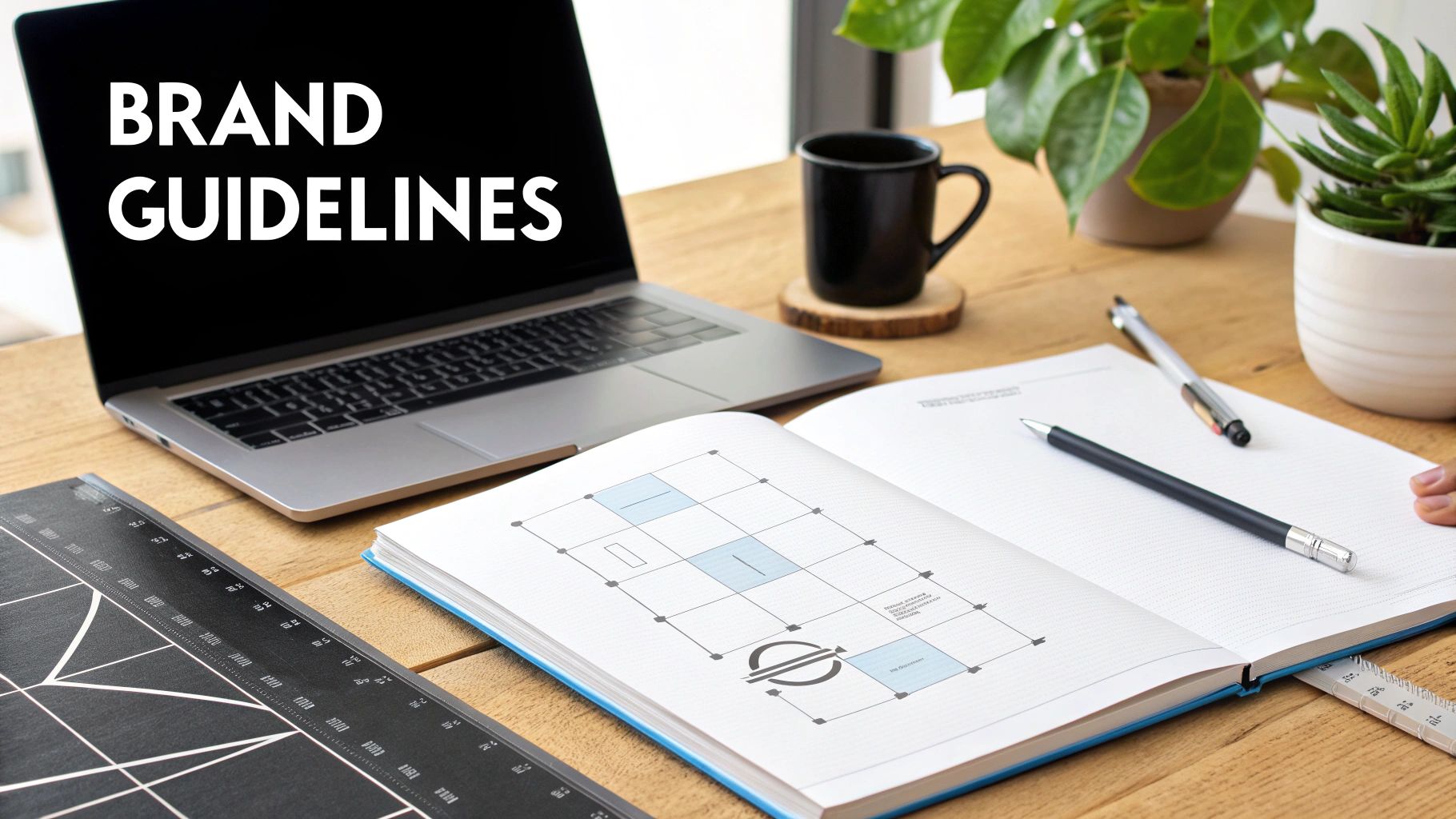
To protect your brand’s integrity, you need a few non-negotiable rules. These guidelines make sure your lockup looks sharp and consistent everywhere it shows up, from a business card to a billboard.
Give It Breathing Room with Clear Space
The most important rule is clear space, sometimes called an exclusion zone. This is the designated "breathing room" or invisible border you must maintain around your lockup at all times.
No other text, graphics, or distracting elements should ever crash this party. Crowding your lockup makes it tough to read and kills its impact. A good designer will define this space for you, often using a piece of your logo (like the height of a letter) as the unit of measurement.
Respect the Minimum Size
Your logo lockup has to be legible whether it’s tiny or huge. That’s why setting a minimum size is so critical. This rule dictates the absolute smallest your lockup can be reproduced while still being perfectly clear.
Going any smaller risks turning your beautifully designed brand elements into an unreadable smudge. This is especially important for things like small print ads in Portage, the footer of your website, or even embroidery on a polo shirt for your team.
These rules aren’t meant to be restrictive; they're designed to be protective. Following them is the key to building a strong, recognizable, and professional brand identity that customers in Northwest Indiana and beyond will trust.
You can learn more about how all these individual rules come together by checking out our guide on how to create brand guidelines for your small business.
Use Approved Color Variations
Your primary, full-color lockup is your go-to, but it won’t work on every background. A professional brand needs a handful of approved color variations to stay flexible. These usually include:
A full-color version: For use on light or white backgrounds.
A reversed (all-white) version: To pop on dark or colored backgrounds.
A single-color (black or another brand color) version: For times when full color isn't an option, like on certain promotional items or documents.
Finally, never stretch, distort, re-color, or re-arrange the elements of your lockup. It was designed with a specific balance and proportion for a reason. Sticking to these golden rules ensures every impression your brand makes is a good one. Need help setting these standards? Call us at 219-764-1717.
Your Top Logo Lockup Questions Answered
We've covered a lot of ground, but you probably still have a few questions. Let's wrap things up by tackling the most common questions we hear from business owners about logo lockups and how to use them correctly.
Our goal is to give you the confidence to handle your visual branding like a pro.
What’s the difference between a logo and a logo lockup?
Think of it this way: a "logo" can be just one piece of the puzzle. It might be the Nike swoosh (that's a logomark) or the "Coca-Cola" script (that's a logotype). It’s a single element.
A logo lockup, on the other hand, is the whole package—the official, locked-in arrangement of all those pieces together. It's the swoosh plus the word 'NIKE' in its specific font. That's the lockup. For your business, this complete version is what you'll use 99% of the time. It’s the key to making your brand look the same everywhere.
How many lockup versions does my small business actually need?
You don't need a million options. You just need the right ones. Most small businesses can knock it out of the park with just a few key variations.
A solid branding package from Creative Graphics Solutions always includes:
A Primary Lockup: This is your go-to, usually a horizontal version. It’s perfect for things like your website header or the side of your truck.
A Secondary Lockup: This is often a stacked or vertical version. It gives you the flexibility you need for tight spots like social media profile pictures.
Color Variations: You'll want full-color, all-white (often called "reversed"), and all-black versions. This ensures your lockup always looks sharp, no matter the background.
What file formats should I have for my logo lockup?
Okay, this is a big one. Getting this right will save you countless headaches. Having the proper files means your brand will look crisp and professional everywhere, from a cheap pen to a massive billboard.
You need two main types of files:
Vector Files (.AI, .EPS, .SVG): These are your golden tickets. They’re built with mathematical formulas, not pixels, which means you can scale them to any size imaginable without them ever getting blurry. For anything that gets printed, these are non-negotiable.
Raster Files (.JPG, .PNG): These are pixel-based and are perfect for digital use—your website, social media posts, or email signatures. A PNG with a transparent background is especially critical.
At Creative Graphics Solutions, we ensure every client walks away with a full suite of files to cover any and every situation. No exceptions.
Can I just make my own logo lockup?
Look, DIY design tools have their place. But creating a professional logo lockup is much more than just dragging a symbol next to some text. It requires a deep understanding of spacing, typography, visual balance, and how a brand should actually feel.
A poorly constructed lockup doesn't just look "off"—it can make your entire business look amateur. It sends a quiet message to customers that you’re willing to cut corners.
Investing in a professional designer isn't just about getting a pretty picture. It's about building a strong, reliable foundation for your brand’s growth. It ensures your lockup is versatile, balanced, and actually works. Honestly, it's one of the smartest marketing investments you can make for your local business.
Ready to get a logo lockup that works as hard as you do? The team at Creative Graphic Solutions is here to help businesses across Northwest Indiana and Chicagoland build brands that get noticed. Give us a call at 219-764-1717 or request a free quote online today. """
Comments